
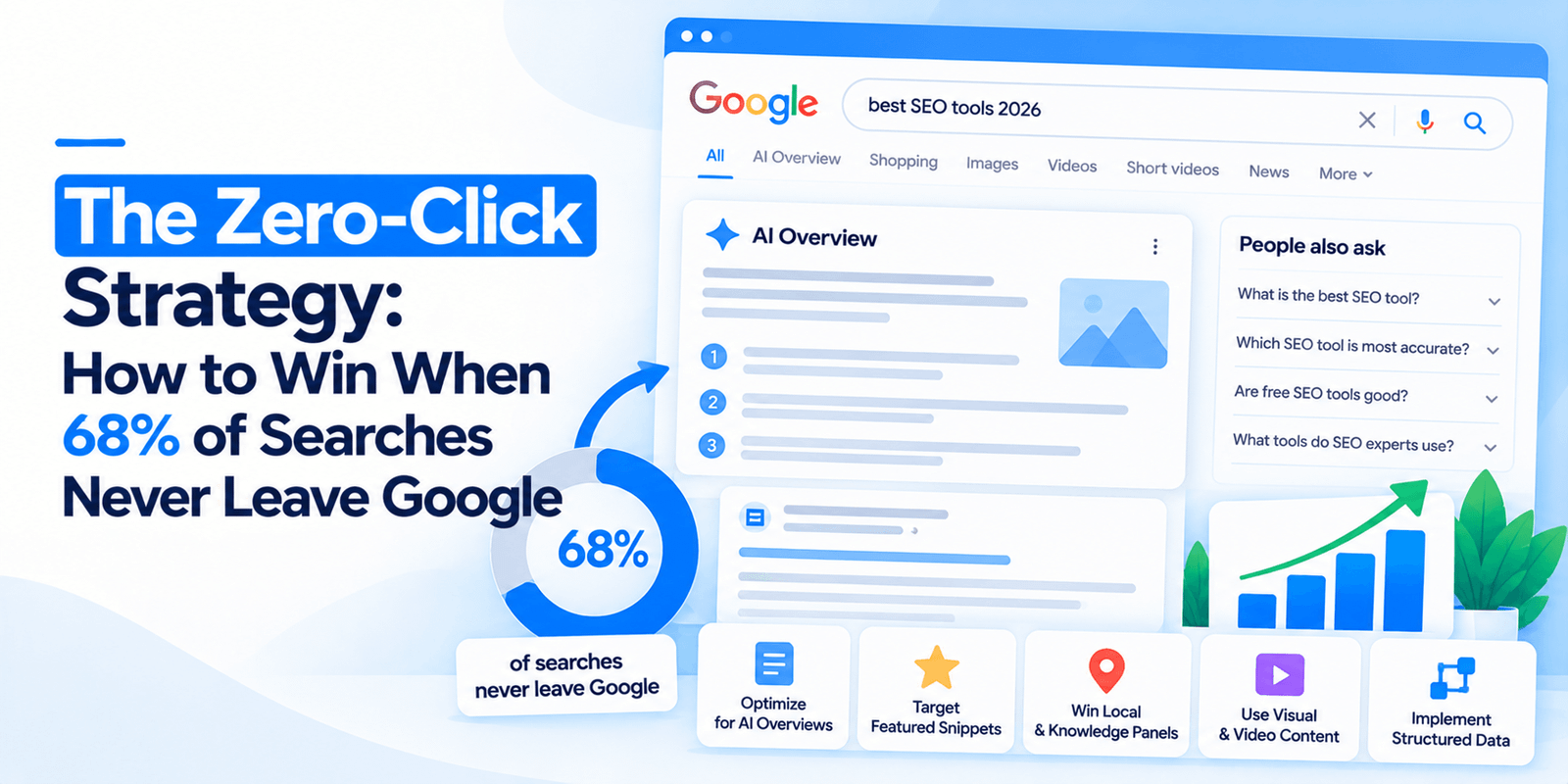
Sixty-eight percent of US Google searches now end without a click to anywhere. Not to your site, not to a competitor, not even to a paid result. That figure comes from SparkToro’s analysis of Similarweb clickstream data covering January to April 2026, and it is up from 60.45% in 2024. The surprising part is what is causing it. AI Mode accounts for 0.34% of Google searches. This is not an AI story. It is a decade of Google building features that keep people on Google, and the strategy that works has almost nothing to do with chasing clicks.
The numbers, with their limits
The headline figure is 68.01%, measured across US browser-based Google searches from January to April 2026 using Similarweb’s clickstream panel, two-thirds mobile and one-third desktop.
Two details make it worse than it sounds. The study excludes the Google Search app entirely, so the real figure is probably higher. And open-web clicks fell from 374 per thousand searches in 2024 to 276 in 2026, a 26% reduction in the actual volume reaching the open web.
Meanwhile the share of searches that lead to another Google search rather than a click out rose 7.2 percentage points over the same two years. People are not leaving. They are searching again.
One honest caveat on the long trend. The decade-long series stitches together three different measurement panels, so the 2016 and 2019 figures are approximate and only the 2024 to 2026 comparison is robust. Anyone showing you a smooth decade curve is smoothing over a methodology change.
Why this is not an AI story
This is where most coverage gets it wrong.
AI Mode accounts for 0.34% of US Google searches. A third of one percent. It cannot be responsible for a 7.5 point shift.
AI Overviews are a bigger factor, appearing on more than 20% of searches and cutting click-through sharply where they appear. But the trend predates them. Zero-click was already above 60% in 2024 and above 45% a decade ago. Featured snippets, knowledge panels, local packs, weather widgets, unit converters, flight results and Google’s own properties have been absorbing clicks for years.
That matters for strategy. If you believe AI caused this, you will wait for AI to be regulated or for the bubble to burst. If you understand it as a decade of structural change, you will build for a world where the click is optional, because that world is not going away.
What the sites that are still winning have in common
This is the most useful research in the field right now. Cyrus Shepard analysed more than 400 websites, comparing those gaining organic traffic year on year against those losing it, and found five characteristics that separated them.
Characteristic | Correlation with traffic growth |
|---|---|
Offers an actual product or service | 0.391 |
Lets users complete a task | 0.381 |
Owns proprietary assets | 0.357 |
Tight topical focus | 0.250 |
Recognisable brand | 0.206 |
Two findings in that data matter more than the ranking.
Around 84% of the winning sites let a user finish what they came to do, against roughly half of the losers. Run the calculator, check availability, book the appointment, configure the product, see the price. Not read about it.
And the traits compound. Having one of the five produced a win about 15% of the time. Having four or five produced a win 68 to 70% of the time. You do not win by doing one thing well. You win by being a destination.
The traffic you do get is worth more
There is a genuine upside buried in this, and it is easy to miss.
Similarweb’s analysis of US desktop traffic found that ChatGPT-referred visitors spent 15 minutes on site against 8 minutes for Google visitors, viewed 12 pages against 9, and converted at 7% against 5% on transactional sites.
Adobe reported AI-referred traffic to US retailers growing 393% year on year in early 2026, converting roughly 42% better than non-AI traffic.
Both figures are vendor-published and neither defines its conversion metric, so treat them as directional. But the direction is consistent across independent sources, and it makes sense: somebody arriving after an AI assistant has already answered their research questions is further down the funnel than somebody who typed a question into Google.
Smaller, better-qualified traffic is not the same as decline.
Three shifts worth making
- Branded demand is the moat. Branded terms account for roughly 44% of Google searches, they still send clicks, and AI systems preferentially cite entities they already recognise. The goal stops being to rank pages and starts being to become a named entity. This is the slowest and most durable of the three.
- Convert rented attention into owned assets. LinkedIn, Instagram and YouTube are where demand gets created, and all three can change their rules tomorrow. An email list, a community and first-party data cannot be revoked by a platform. Use the rented channels for reach and move people into something you own.
- Stop using traffic as the scoreboard. This is the hardest shift and the one most agencies resist, because traffic is easy to report. The honest replacement is a correlation dashboard: does branded search volume, direct traffic and revenue move when you show up where your audience already pays attention? That is less precise than click attribution and no more fictional, since click attribution has been broken by privacy changes, ad blockers and dark social for years.
A practical way to triage your keywords
If you want one actionable framework, sort your target queries by how often they produce a click at all, then treat each tier differently.
Under 30% zero-click. Standard SEO. Rankings and click-through rate still matter here, and these are usually transactional or navigational.
30 to 50%. Hybrid. Rank for the click and structure for the citation.
50 to 70%. Citation play. Write for extraction: answer in the opening sentences, use self-contained sections, include a specific figure.
Above 70%. Pure citation play. Traffic is not the success metric here and should not be reported as one. Be the cited source or skip the query.
Informational queries cluster at the top of that range. Transactional and navigational queries cluster at the bottom. Your keyword list almost certainly contains both, and treating them identically is why most content strategies are now underperforming.
What to measure instead
Five things, none of which is sessions.
- Branded search volume over time, from Search Console filtered to your brand. The clearest downstream signal that awareness is working.
- Citation rate across a fixed set of buyer prompts, checked monthly.
- Share of voice against named competitors in AI answers.
- Assisted conversions and direct traffic, watched for correlation with publishing and visibility work.
- Task completions on your own site, which is the thing the winning-sites research says actually separates survivors from casualties.
The uncomfortable summary
A lot of content strategies were built on a model where publishing useful information earned traffic that earned revenue. The middle step is being removed, and no amount of optimisation puts it back.
What survives is having something to sell, something only you have, a brand people search by name, and a site where a person can finish the job. That is a harder business to build than a content calendar, and it is considerably harder to copy.
We write about this monthly
We track zero-click rates, AI citation behaviour and what is actually working for US businesses, and send a short summary once a month. No pitch, just what changed.
Frequently Asked Questions
What percentage of Google searches end without a click?
68.01% of US Google searches ended without a click to anywhere between January and April 2026, according to SparkToro’s analysis of Similarweb clickstream data. That is up from 60.45% in 2024. The study covers browser-based searches only and excludes the Google Search app, so the true figure is likely higher.
Is AI causing zero-click searches?
Not primarily. AI Mode accounts for just 0.34% of US Google searches, far too small to explain a 7.5-point shift. AI Overviews contribute, appearing on more than 20% of searches, but zero-click was already above 60% in 2024 and above 45% a decade ago. The cause is years of Google features — snippets, knowledge panels, local packs, converters — keeping people on Google.
What do websites still gaining search traffic have in common?
Analysis of more than 400 sites found five traits, correlated with traffic growth in this order: offering a product or service (0.391), letting users complete a task (0.381), owning proprietary assets (0.357), tight topical focus (0.250) and a recognisable brand (0.206). Around 84% of winners let users finish a task, against half of losers.
What should I measure instead of traffic?
Branded search volume from Search Console, citation rate across a fixed set of buyer prompts, share of voice against named competitors in AI answers, assisted conversions and direct traffic watched for correlation, and task completions on your own site. Traffic becomes a secondary metric rather than the scoreboard.
Is AI search traffic better quality than Google traffic?
The available data suggests yes, though it is vendor-published. Similarweb found ChatGPT-referred visitors spent 15 minutes on site against 8 for Google, viewed 12 pages against 9, and converted at 7% against 5% on transactional sites. Adobe reported AI-referred retail traffic converting roughly 42% better. Smaller volume, higher intent.
Should I stop doing SEO because of zero-click search?
No, but its job has changed. Transactional and navigational queries still produce clicks and still reward conventional SEO. Informational queries increasingly do not, and for those the goal is being the cited source rather than earning the visit. Sort your keywords by how often they produce a click and treat each group differently.