

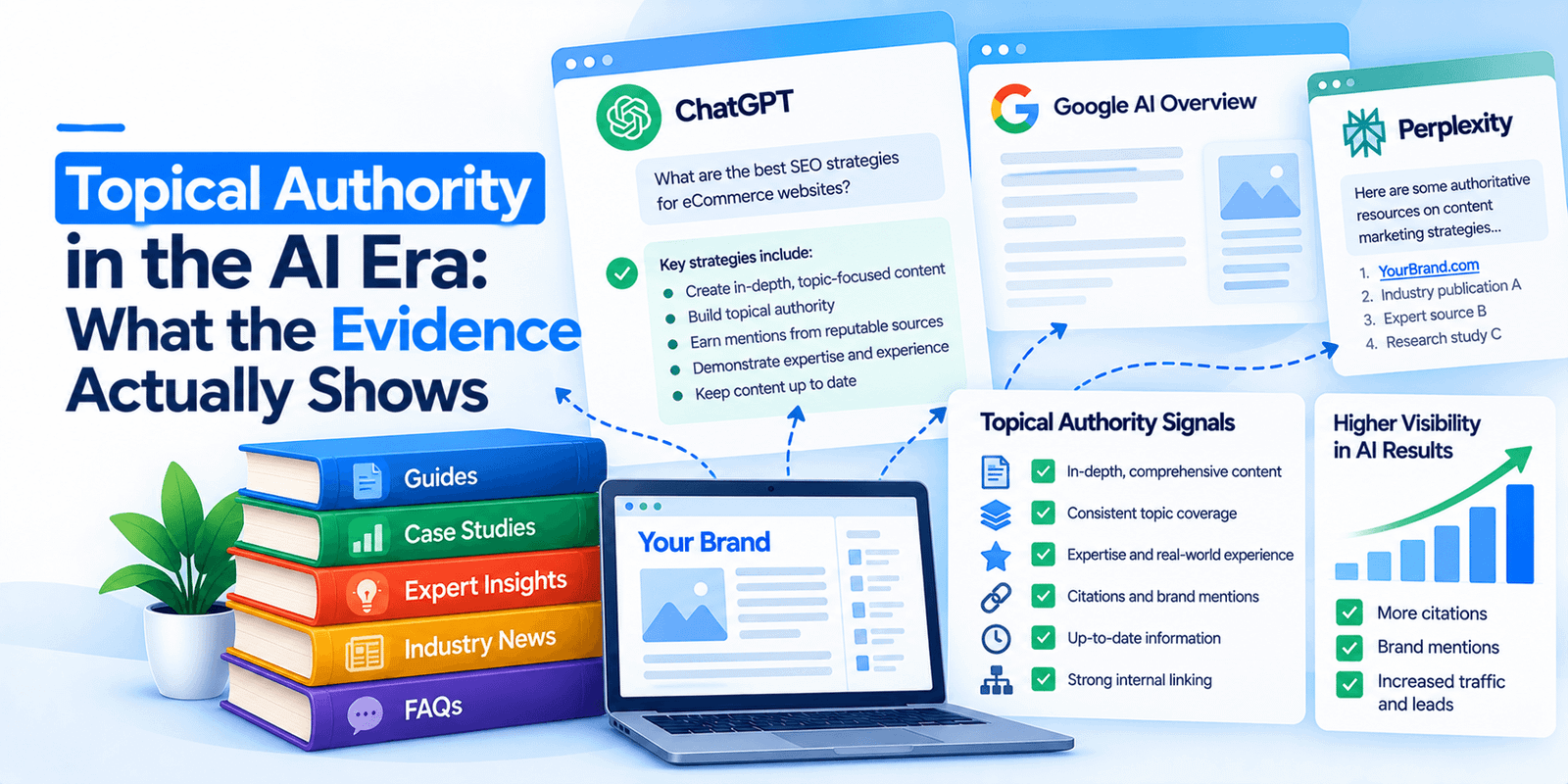
Both sides of the topical authority argument are running on bad evidence. The people selling you a thirty-article content cluster cannot point to a study. The people telling you Google debunked topical authority are citing a one-word Reddit reply from 2023.
Meanwhile there is one piece of real measurement on what makes AI systems cite a brand, and it found that the number of pages on your site has almost no relationship with being cited. That is the finding worth building a content strategy around. Here is the whole picture, as of October 2026.
What did Google actually say?
The claim that Google debunked topical authority traces back to a specific moment, and it is thinner than its reputation.
In November 2023, on Reddit, a commenter argued that topical authority is a fancy new term invented by SEO gurus for what has always been called relevancy. John Mueller of Google replied with a single word: “This.” He later added, in a follow-up, that people should not worry about topical authority.
That is the entirety of the Google-attributed material. Two short comments on Reddit.
The trade coverage of those comments went considerably further, stating that there is no actual authority score at Google and that the practice of linking related articles to each other has no basis in reality. Those are the journalist’s conclusions, not Google’s words, and they are the versions that got repeated.
So what Google actually endorsed is narrow: that topical authority is a repackaging of relevance, and that it is not worth worrying about as a concept. That is not the same as saying topical depth does not help you rank, and the industry has spent three years conflating the two.
But what about the leaked documents?
Fair question, and the honest answer is that the leak does not settle this.
In May 2024, documentation apparently from inside Google surfaced and was analysed publicly. It generated a great deal of commentary about ranking factors. The trade coverage of it does not address topical authority, content clusters or content volume anywhere, which is the first thing to know if someone cites it at you on this subject.
The second thing is that the interpretive limits are severe, and the coverage itself says so. Just because something appears in API documentation does not mean it is used to rank search results. The documentation may relate to testing, or to specific verticals. The documents were roughly a year old when they surfaced. And notably, the former Google employees who looked at them confirmed only that the material appeared to originate from within Google, not that it came from Search.
Google’s own statement was a caution against making inaccurate assumptions about Search based on out-of-context, outdated or incomplete information.
Treat the leak as interesting and not probative. Anyone using it to prove that topical authority is a scored attribute is overreaching in the same direction as the people who used a Reddit comment to prove it does not exist.
What measurement actually exists?
Here is the part that should change what you do.
Ahrefs studied 75,000 brands, measuring how often each appeared across millions of AI responses in ChatGPT, Google AI Mode and AI Overviews, using Spearman rank correlation.
Factor | Correlation with AI visibility | What it is |
|---|---|---|
YouTube mentions | ~0.737 | Brand name in a video title |
Branded web mentions | 0.656 – 0.709 | Pages mentioning the brand |
Branded anchors | 0.511 – 0.628 | Links using the brand name as anchor |
Branded search volume | 0.352 – 0.466 | People searching the brand |
Domain Rating | 0.266 – 0.326 | Link-based authority metric |
Number of pages on the site | ~0.194 | “Almost no relationship” |
Read that ordering carefully. The thing most content strategies optimise for — publishing more pages on a subject — is at the bottom. The things at the top are all forms of other people talking about you.
Three caveats, because this is correlational and the authors say so themselves. Correlation is not causation, and they explicitly allow that these factors may be markers of existing brand strength rather than causes of citation. The sample was restricted to established brands, domains with Domain Rating above 40 whose top keyword had at least 800 monthly searches. And there are no significance tests published.
It is still the only large dataset on the question, and its ordering is hard to explain away. Whatever is going on, page count is not what distinguishes brands AI systems cite from brands they ignore.
What do people actually mean by topical authority?
The term is doing two jobs, and separating them resolves most of the argument.
The first job is describing a real phenomenon: sites that cover a subject thoroughly and are referenced by others on that subject tend to do well in it. Nobody disputes this. Mueller’s point was that this is what relevance has always meant.
The second job is selling a tactic: publish a pillar page, publish twenty supporting articles, interlink them, and authority accrues. This is the part with no evidence behind it, and it is the part the AI citation data most directly undercuts.
The tactic is not useless. Organising content into logical sections with sensible internal links is good site architecture, helps crawlers find things, and helps readers. It is just not a mechanism for manufacturing authority, and it will not get you cited by an AI system on its own.
What should you do instead?
Five things, ordered by the evidence behind them rather than by how much work they look like.
Stop measuring content strategy in article count. If your plan is expressed as a number of posts per month, it is optimising the one variable with almost no measured relationship to AI citation. Twenty thin articles on a topic perform worse than four good ones plus the effort that would have gone into the other sixteen spent on getting mentioned.
Consolidate what you already have. Most sites that have published for a few years have five near-duplicate posts on their main subject, splitting whatever signal exists between them. Merging those into one authoritative page with the others redirected is usually the highest-return content work available, and it reduces page count rather than increasing it.
Spend the freed-up effort on mentions. The top-correlating factors are all third-party references. A podcast appearance, a trade publication quote, a genuinely useful contribution to an industry discussion — these are what the data points at.
Keep the internal linking, drop the mysticism. Link related pages because it helps people navigate and helps crawlers discover. Do not expect the link graph itself to generate authority.
Be the clearest source on the questions you want to be known for. This is the version of topical coverage that survives scrutiny: if someone asks an AI assistant a question in your field, is there a page of yours that answers it plainly, with specifics, in a form that can be quoted? That is a question about quality and structure, not volume.
A note on content audits
If you are sitting on a hundred posts and wondering which of this applies to you, the useful exercise is unglamorous. Pull every page, check impressions and clicks over the last six months, and sort.
You will typically find a small number of pages doing nearly all the work, a long tail getting nothing, and several clusters of pages competing with each other for the same query. The long tail is not building authority. It is diluting it and consuming crawl budget, and some of it is actively confusing an AI system about what your site is for.
The answer is usually to merge, redirect or delete more than you publish for a quarter.
The honest summary
Topical authority is a real phenomenon with a misleading name and a tactic attached that nobody has demonstrated works. Google’s actual comment on it was two sentences on Reddit saying it is relevance renamed and not worth worrying about. The leaked documentation does not address it.
The one real measurement on AI citation puts page count at the bottom of the list and third-party mentions at the top. So cover your subject properly, link sensibly, and then stop adding pages and start earning references.
If your current content plan is a monthly article quota, the evidence says you are optimising the wrong number.
Frequently asked questions
Is topical authority a real Google ranking factor?
Google has never described one. The only Google-attributed comment is John Mueller on Reddit in November 2023, endorsing the view that topical authority is relevance under a new name and advising people not to worry about it. The stronger claims circulating — that there is definitively no authority score — come from trade commentary, not Google.
Do content clusters still work in 2026?
As site architecture, yes — logical sections with sensible internal links help readers and crawlers. As a mechanism for accruing authority, there is no evidence. The largest study on AI brand visibility puts number of site pages at roughly 0.194 correlation, described as almost no relationship.
How many articles do I need to build topical authority?
Article count is the wrong metric. In Ahrefs’ 75,000-brand analysis, page count correlated least of all the factors tested with appearing in AI responses, while third-party mentions correlated most. Four strong pages plus earned mentions beats twenty thin ones.
Did the Google documentation leak prove topical authority exists?
No. The trade coverage of the 2024 leak does not address topical authority, content clusters or content volume at all. It also notes that a field appearing in API documentation does not mean it is used in ranking, that the documents were about a year old, and that ex-Google reviewers confirmed only that the material appeared to come from within Google rather than from Search.
What should I do with old blog posts that get no traffic?
Audit and consolidate. Pull every page, sort by clicks and impressions over six months, and look for near-duplicates competing for the same query. Merging those into one page and redirecting the rest is usually higher-return than publishing something new.
Want to know which of your pages are actually working?
A content audit sorts every page you have by what it earns, finds the ones competing with each other, and tells you what to merge, what to improve and what to delete.
Get a content audit. Most of the value is usually in what you stop publishing.