
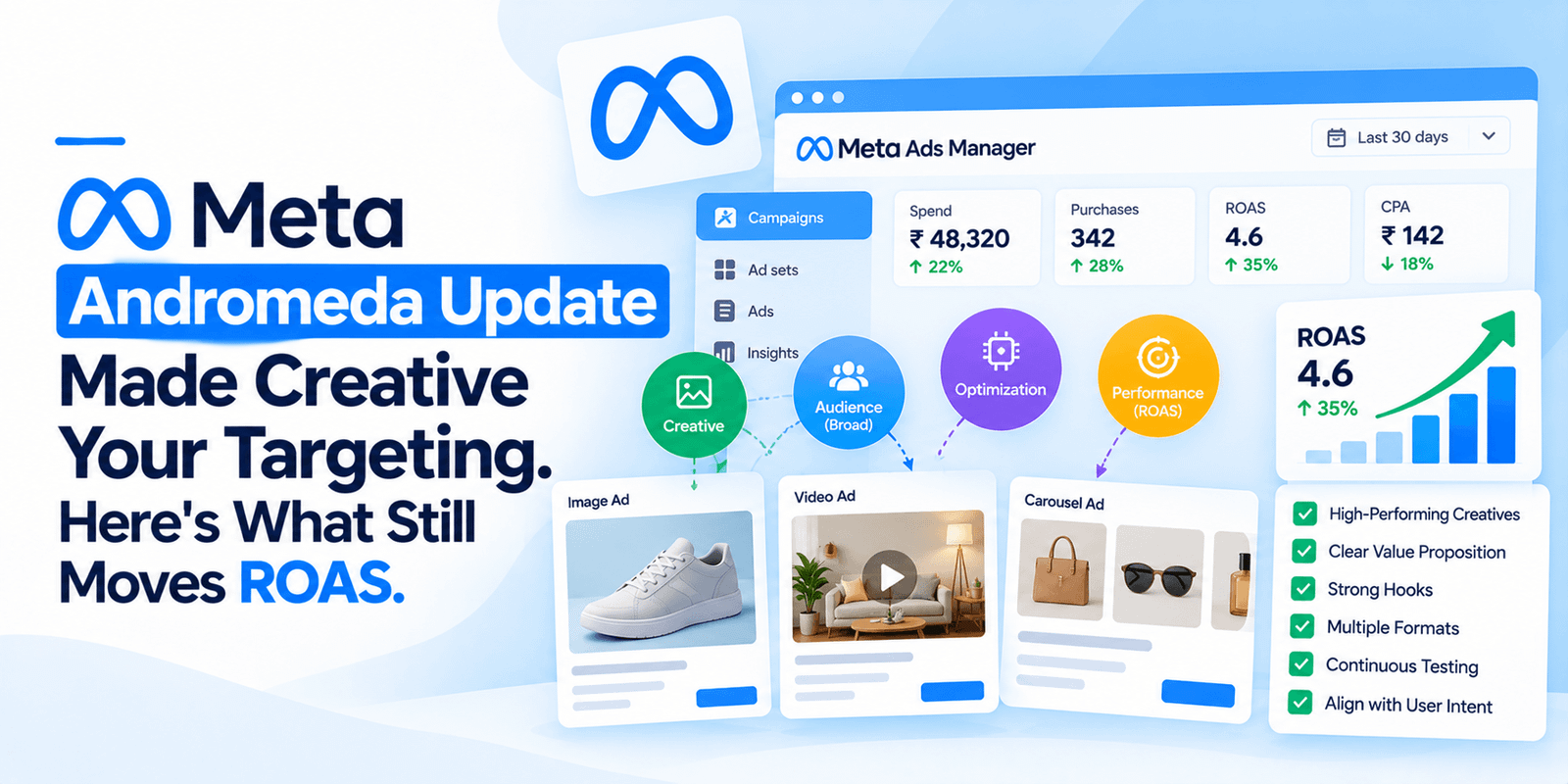
Meta’s ad system no longer asks who should see this ad. It asks which ad should this person see.
That inversion, driven by a retrieval engine called Andromeda, is why your targeting settings stopped mattering and your creative started carrying the whole campaign. The most important practical consequence is one almost nobody acts on: Meta now treats visually similar ads as a single entity, so running ten variations of the same product shot gets you one shot at distribution, not ten.
What Andromeda actually is
Andromeda is Meta’s ads retrieval engine. Meta’s own engineering blog describes it as a next-generation personalised ads retrieval system built on a custom deep neural network running on NVIDIA Grace Hopper hardware, reporting a 10,000-fold increase in model capacity, three times faster query speed and 100 times faster feature extraction.
Agency accounts put the deployment in December 2024, with the rollout substantially complete by late 2025 and effectively universal by early 2026. Those dates come from practitioners rather than Meta announcements, so treat them as approximate.
The mechanical change is the part that matters. Previously you defined an audience and Meta found people within it. Now the system reads your creative, extracts attributes from it, and routes impressions to people whose behaviour matches those attributes. Your targeting inputs became suggestions.
Your creative is your targeting now. That phrase gets repeated a lot and for once it is literally accurate rather than a slogan.
The finding that should change what you do on Monday
Andromeda clusters visually similar ads and treats them as one entity.
Two independent agency accounts describe the same behaviour: run ten variations of the same static product shot with different headlines, and they do not get ten chances at distribution. They get one. The old playbook of one winning image plus a dozen copy variants now produces almost no incremental reach.
This is the single highest-value thing to know about Meta advertising in 2026, and it inverts a decade of accepted practice. Variation testing was the discipline. Variation is now largely invisible to the system.
What replaces it is conceptual diversity. Different visual execution, different message, different format, different awareness stage. Not different headlines over the same photo.
The old playbook | What it does under Andromeda |
|---|---|
One winning image, twelve headline variants | Collapses into one entity. Twelve ads, one chance at distribution. |
Narrow interest-stacked audiences | Largely overridden. Creative attributes drive routing instead. |
Five ad sets, three similar creatives each | Signal split five ways, and the creatives cluster anyway. |
Let the winner run for two months | Fatigue now lands in two to four weeks. |
Test one variable at a time | Cosmetic variables are invisible. Test concepts, not variables. |
The diagnostic Meta hands you for free
Ads Manager now exposes two things worth checking today: Creative Similarity and Top Creative Themes.
Practitioner guidance clusters around keeping similarity below roughly 40% and treating anything above 60% as a problem. Those thresholds come from agency testing rather than Meta documentation, and at least one of the practitioners who published them says explicitly that they should be treated as directional rather than hard limits. Use them to compare your own account against itself over time, not as a pass mark.
If you check one thing after reading this, check that number.
A word about the statistics you will see
This is worth saying plainly, because the figures circulating about Andromeda are repeated everywhere and sourced almost nowhere.
You will encounter claims that average ROAS fell 7% during the rollout, that high-ticket ROAS fell 31%, that landing page conversion rates dropped from 3.5% to 2.9% industry-wide, that brands testing twenty or more new ads a month see 65% higher ROAS, and that Advantage+ with AI creative features delivers a 22% improvement. We tried to trace these. Most are attributed to unnamed studies, and the ones with an identified origin are agency internal data presented without methodology or sample definition.
That does not make them wrong. It does mean nobody should be building a budget case on them.
The figures with an actual named owner are more modest. Common Thread Collective reports from its own portfolio of more than 170 brands that CPMs rose 28% year on year and click-through rate rose 43% while conversion rates fell. That is first-party agency data, correlational, and at least attributable. The interpretation they offer is reasonable: the ads reached more people, and the wrong ones.
Treat the direction as real and the decimal places as decoration.
What still moves ROAS
Four things, in order of how much control you actually have.
Conceptual creative diversity. This is now the primary lever and it is a production problem rather than a media-buying one. Rough volume guidance from practitioners, by monthly spend: under $10,000, eight to twelve genuinely distinct new concepts a month. Between $10,000 and $50,000, fifteen to twenty-five. Above that, twenty-five to forty or more with weekly refresh. The word doing the work is distinct.
A useful production shortcut is to vary deliberately along three axes rather than improvising. Who it is for: the price-sensitive buyer, the gift buyer, the replacement buyer, the sceptic. What they already believe: unaware of the problem, aware but not shopping, comparing options, ready to buy. What format it takes: founder to camera, user-generated review, text-led static, demonstration, before and after. Five angles across three formats gives you fifteen genuinely different creatives from one brief, and because the executions differ structurally rather than cosmetically, they are far more likely to land in separate entity clusters.
Conversion signal quality. Exactly as with Google’s automation, the system optimises toward what you tell it success looks like. Server-side conversions, accurate event values, and offline imports where relevant matter more under automation than they did under manual targeting, because there is no longer a targeting layer compensating for a bad signal. If you pass a flat value on every purchase while your order values range from $20 to $400, the system cannot tell a good customer from a bad one and will optimise toward whichever is cheaper to find.
Catalog ads, if you sell products. Multiple sources point at these as materially outperforming standard placements, though the specific percentages are among the unsourced figures above. The structural logic holds regardless: a catalog feeds the system far more attribute data to work with than a single creative does.
Account structure. Consolidation generally beats fragmentation now. If you are running several campaigns and none is reaching roughly fifty conversions a week, the system has too little signal in each to learn from. Fewer, better-fed campaigns outperform many starved ones.
Creative fatigue arrives faster
Both agency accounts report effective ad lifespan compressing from roughly six to eight weeks down to two to four. Neither cites Meta for it.
If that matches your experience, the implication is operational rather than tactical. Your creative production has to run ahead of the fatigue window permanently, which means a weekly cadence rather than a campaign-launch cadence. Most accounts that struggle under Andromeda are not making bad creative. They are making it too slowly.
How to test creative now
A reasonable method, assembled from practitioner guidance rather than Meta documentation.
Build eight to twelve conceptually distinct creatives. Before launching, check each against what is already running: if the message, the visual execution and the format all match something live, it probably shares an entity cluster and will not get its own distribution.
Launch with one creative per ad set, equal budgets, broad targeting, and the same optimisation event as your scaling campaign. Give it seven days minimum, longer for considered purchases, and enough impressions per creative that the numbers mean something.
Judge on more than cost per acquisition. Hook rate, measured as three-second views divided by impressions, tells you whether the opening works. Hold rate tells you whether the rest does. A creative with a strong hook and a mediocre cost per acquisition is often worth keeping and reworking rather than killing, because the expensive part, getting attention, is already solved.
Expect a hit rate around five to ten percent. Most creatives fail. That is the cost of the diversity the system now requires, and it is why production speed beats production polish.
The honest summary
Meta took away the levers most media buyers were trained on and left one: what the ad actually is.
That is uncomfortable if your competence was in audience construction, and it is good news if you can produce genuinely different creative quickly. The accounts doing well under Andromeda are not the ones with the cleverest targeting. They are the ones with a functioning creative pipeline and a clean conversion signal.
Want to know what your account looks like under this?
We will check your creative similarity, audit your conversion signal quality, look at whether your account structure is starving the system, and tell you where the waste is.
Get a free Meta Ads account audit. No charge, and the findings are yours either way.