

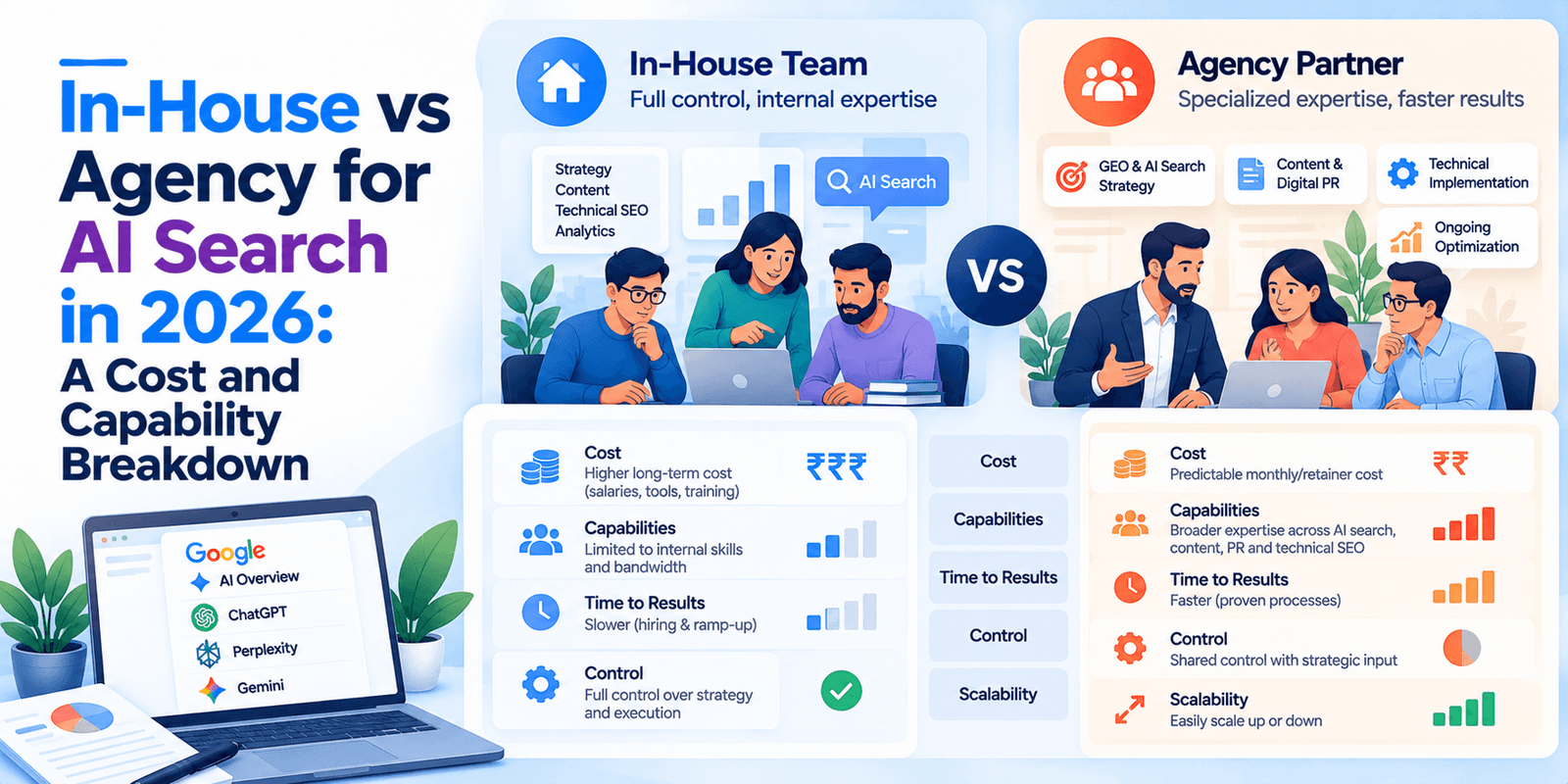
One in-house marketing hire costs between roughly $9,100 and $14,400 per month once you account for what employment actually costs, against agency retainers of $1,500 to $8,000. So for most US businesses, the honest answer is that a single hire is the more expensive option and covers less ground.
That is not an argument for agencies in general. It is an argument about one specific thing: AI search work requires four different skill sets, and the crossover point where building a team beats buying one is higher than most people assume. Here is the arithmetic, as of October 2026, including the cases where in-house clearly wins.
Why is the number you are imagining for a hire too low?
Most people compare a salary to a retainer. That comparison is wrong by about half.
The US Bureau of Labor Statistics publishes what employment actually costs through its Employer Costs for Employee Compensation series. In the June 2026 release, for management, business and financial occupations in private industry, wages and salaries averaged $59.85 per hour worked and benefits averaged $28.78, putting total compensation at $88.63.
Work that backwards. Benefits are 48% on top of salary, not a rounding error. Those costs break down into paid leave, supplemental pay and bonuses, insurance, retirement contributions, and legally required items including Social Security, Medicare, unemployment insurance and workers’ compensation. You pay them whether or not the employee uses them.
Base salary | Total compensation (+48%) | Per month | With tooling |
|---|---|---|---|
$70,000 | ~$103,700 | ~$8,640 | ~$9,100 – $9,500 |
$90,000 | ~$133,300 | ~$11,100 | ~$11,600 – $11,900 |
$110,000 | ~$162,900 | ~$13,600 | ~$14,100 – $14,400 |
Tooling for this work runs somewhere around $6,000 to $10,000 a year once you have an SEO platform and at least one AI visibility tracker. Published prices in the AI visibility category move constantly and nearly every comparison of them is written by a competing vendor, so treat that as a planning range rather than a quote.
A note on precision: BLS reports these costs per hour worked, and converting to an annual figure requires an assumption about hours that BLS does not supply. The 48% loading is the reliable part. The monthly totals above are illustrative, and your own numbers will differ with state unemployment rates and what health plan you offer.
What actually decides it?
Cost is not the interesting variable. Coverage is.
AI search work is four jobs:
Technical implementation — schema, crawler access, site structure, Core Web Vitals, making content machine-readable.
Content production — restructuring existing pages so answers come first, writing new material at some volume.
Digital PR and mention building — earning third-party coverage, which is what the research consistently shows correlates most with being cited by AI systems.
Measurement — running prompt tests across four or more platforms monthly, maintaining a baseline, segmenting AI referral traffic in analytics.
One hire is good at one or two of these. The technical SEO who can fix your schema is rarely the person who can get you quoted in a trade publication. The content person is rarely the person who will debug your rendering. Nobody is all four, and anyone claiming to be is probably mediocre at three of them.
This is the genuine structural argument for buying rather than building at small scale, and it has nothing to do with agencies being cheaper per hour. It is that a $9,100 monthly hire gives you one skill set and a $4,000 retainer gives you four partial ones. At low volume, breadth beats depth.
When does in-house genuinely win?
Four situations, and they are real rather than token.
You publish at high volume year-round. If you need eight or more substantial pieces a month indefinitely, in-house content production becomes cheaper per unit than agency production, and the quality tends to be better because the writer knows your business. This is the clearest case.
Your subject matter is genuinely hard. Medical, legal, engineering, regulated finance. Agencies struggle with content that requires real domain expertise, and the review burden of fixing their drafts can exceed the cost of writing your own. If your team is already spending hours correcting agency copy, you are paying twice.
You need responsiveness an agency cannot match. If marketing decisions happen in the same meeting as product decisions, an external team on a weekly call will always be a step behind.
Your spend is already past the crossover. If you are paying an agency $12,000 a month, that is two capable people fully loaded. At that point building a team is usually both cheaper and better, and the main reason not to is that hiring takes six months and carries risk a retainer does not.
What does an agency actually give you, and what does it not?
Being even-handed about this matters more than being persuasive, so here is both sides plainly.
What you get: four skill sets rather than one, tooling already paid for, pattern recognition from other accounts, and the ability to stop in thirty days. That last one is underrated — a bad hire takes months and real money to unwind, while a bad retainer takes a notice period.
What you do not get: the same depth of knowledge about your business that an employee accumulates, undivided attention, or anyone whose only job is you. Agencies also have an incentive to keep retainers going, which is worth being alert to. Ask what the exit looks like before you sign, not after.
And the thing nobody in the industry says out loud: agency quality varies enormously, and the difference between a good one and a bad one is larger than the difference between a good agency and a good hire. Post 6 in this series covers how to tell them apart, and it is worth reading before signing anything.
What arrangement usually wins?
For most mid-size companies, neither option as stated is the right answer.
The pattern that works is one internal owner plus external execution. Hire or assign one person who owns the strategy, knows your business, holds the relationships internally and can judge whether the work is good. Buy the specialist execution — technical implementation, digital PR, measurement tooling — from outside.
That costs more than an agency alone and less than a team, and it fixes the failure mode of both. Agencies fail when nobody internal owns the outcome and the work drifts. In-house teams fail when one generalist is expected to cover four specialisms and quietly does only the two they are comfortable with.
What should you do at your budget?
Monthly commitment to the whole function | Recommendation |
|---|---|
Under $1,500 | Do it yourself. Crawler access, Organization schema, restructuring your top pages, review acquisition. Four to six hours a month. |
$1,500 – $4,000 | Agency or specialist freelancer. A hire is not affordable here and a thin one would be worse than nothing. |
$4,000 – $9,000 | Agency, and start building internal ownership. Still below the cost of one properly loaded hire. |
$9,000 – $15,000 | The genuine crossover. One hire is affordable but covers one skill set. Hybrid is usually strongest in this band. |
Above $15,000 | Build the team, keep specialists on retainer for digital PR and technical work. |
Which three mistakes cost the most?
Comparing salary to retainer. You now know this is wrong by about 48% before tools. Any internal business case built on the salary alone is understating the hire by thousands a month.
Hiring one generalist for four specialisms. The predictable result is that the two comfortable jobs get done and the two uncomfortable ones — usually digital PR and measurement — quietly do not. Six months later nobody can say whether the investment worked, because nobody set up the baseline.
Buying a retainer with no internal owner. This is the most common way agency money gets wasted, and it is not the agency’s fault. Someone on your side has to read the reports, judge the work and make decisions from it. If nobody has that in their job description, the retainer will drift for a year before anyone notices.
The honest summary
For most US small and mid-size businesses, an agency or specialist is the cheaper and broader option, because one fully loaded hire costs more than most retainers and covers a quarter of the required ground.
In-house wins on sustained content volume, hard subject matter, speed, and at scale. The crossover sits somewhere around $9,000 to $15,000 a month of committed spend, and in that band a hybrid usually beats either pure option.
And if you are currently paying an agency more than $12,000 a month without an internal owner, you are probably in the worst of both arrangements.
Frequently asked questions
Is it cheaper to hire an SEO or use an agency?
For most small and mid-size businesses, an agency. One hire costs roughly $9,100 to $14,400 a month fully loaded, because US Bureau of Labor Statistics data puts benefits at 48% on top of salary for this occupational group. Agency retainers for this work run $1,500 to $8,000.
What is the true cost of an in-house marketing hire?
Salary plus about 48%, plus tooling. BLS June 2026 data for management, business and financial occupations in private industry shows wages averaging $59.85 per hour worked against $28.78 in benefits. A $90,000 salary is therefore roughly $133,300 in total compensation, or about $11,100 a month before tools.
At what point does in-house become worth it?
Around $9,000 to $15,000 a month of committed spend, and sooner if you publish eight or more substantial content pieces a month, work in a technically hard field, or need same-day responsiveness. Below that band one hire costs more than a retainer and covers one of the four required skill sets.
Can one person do AI search optimization in-house?
Partly. The work splits into technical implementation, content production, digital PR and cross-platform measurement. Most people are strong in one or two. The common failure is that digital PR and measurement quietly go undone, leaving no baseline to judge the investment by.
What is the best setup for a mid-size company?
One internal owner who holds the strategy and can judge quality, plus bought-in specialist execution. It costs more than an agency alone and less than a team, and it avoids both failure modes — agency work drifting with no internal owner, and a lone generalist covering only half the job.
Want to know which side of the line you are on?
A strategy call will work through your actual numbers — what you are spending now, what you would need to cover, and whether hiring, outsourcing or a mix is cheaper for your situation.
Book a strategy call. If the answer is that you should hire rather than retain us, we will say so, and tell you what to look for.