
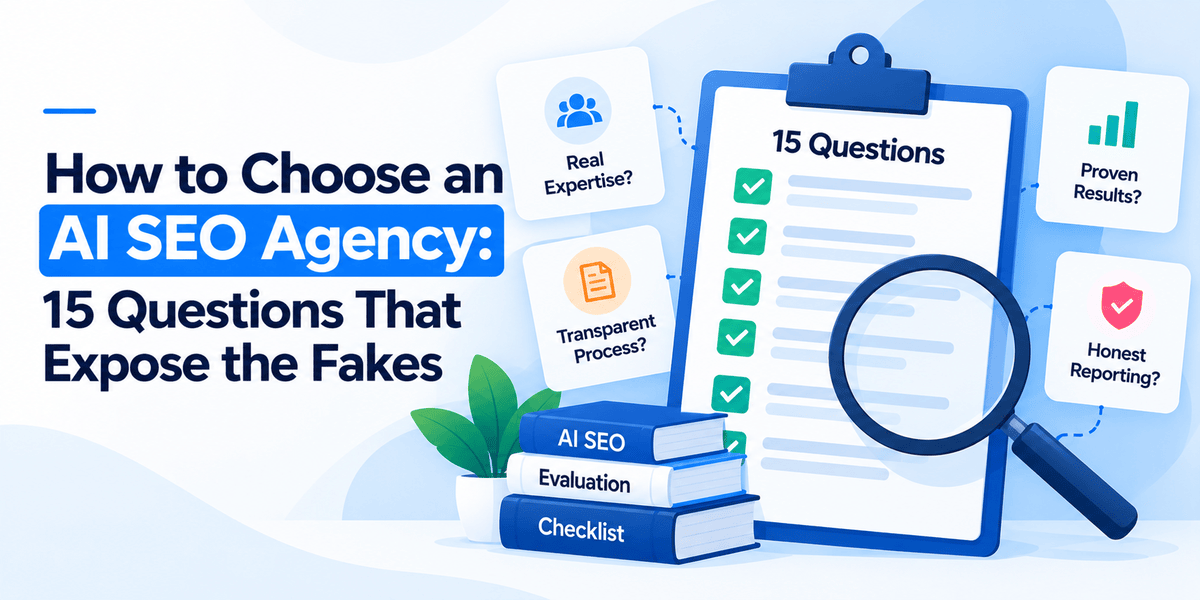
Most agencies selling AI SEO in 2026 rebranded their existing SEO deck six months ago. Some are excellent. Telling them apart takes fifteen questions, asked on a call, and listening for whether the answer contains a method or an adjective. Each question below comes with what a good answer sounds like and what a bad one sounds like, so you can score the call while you are on it.
Group 1: Do they understand the mechanism?
An agency that cannot explain how AI answers get assembled cannot influence them.
- Where do AI assistants get the information they cite?
Good: They describe retrieval from a live index, differences between platforms, and the role of third-party sources. They mention that ChatGPT now runs its own index alongside external providers.
Bad: “Proprietary methodology.” “Our AI system.” Any answer that never mentions where the data actually comes from.
- Which crawlers need access to my site, and how do I check?
Good: They name GPTBot, OAI-SearchBot, PerplexityBot, ClaudeBot and Google-Extended, and they tell you to check your firewall settings as well as robots.txt.
Bad: Vagueness about crawlers, or robots.txt only. Managed hosts and CDNs block AI bots by default far more often than robots.txt does, and an agency that does not know this will miss the most common cause of invisibility.
Good: A small number, honestly stated, with the point that the bigger effect is lost clicks inside Google rather than referrals from ChatGPT.
Bad: Anything implying AI search is about to replace Google. An agency that oversells the size of the channel is either uninformed or willing to mislead you, and neither is what you want.
- What would you tell me not to spend money on?
Good: A real answer. Perhaps that your reviews matter more than your schema right now, or that your industry has low AI Overview coverage so this is not urgent.
Bad: Nothing. An agency that thinks you need everything they sell is selling, not advising.
Group 2: Will they measure honestly?
This is where most of the fakery lives.
- What exactly will you measure?
Good: Citation share of voice across a defined prompt set, plus AI referral traffic and branded search as secondary signals.
Bad: Rankings and traffic. That is traditional SEO reporting with a new cover page.
- Can I see your prompt list?
Good: They show you twenty to thirty questions your buyers would actually type, or they explain how they will build that list with you in week one.
Bad: They do not have one. Without a prompt list there is no baseline, no measurement, and no way to know whether anything worked.
- Will you run a baseline before we start?
Good: Yes, and they describe it. Current citation rate, which competitors appear instead, which pages are already cited.
Bad: They want to start work immediately. An agency that skips the baseline has removed the only evidence that could hold it accountable.
- How do you report a number that changes every time you ask?
Good: They acknowledge AI answers are probabilistic. They report rates across repeated runs, not single positions.
Bad: They quote your exact ChatGPT ranking as a fixed figure. This is the clearest tell in the entire list. There is no such number, and an agency reporting one is either fabricating it or does not understand the system.
Group 3: What will they actually do?
- How much of the work happens off my website?
Good: A meaningful share. Reviews, directory consistency, editorial placements, expert quotes.
Bad: All on-site. Schema and FAQs alone are an SEO proposal wearing a GEO label, and they will not move the signals that decide whether a model recommends you.
- Who writes the content, and is it AI-generated?
Good: A straight answer either way, with a described human editing and fact-checking process.
Bad: Evasion. AI-assisted drafting is normal and fine. Unedited AI output published at volume is not, and an agency that will not tell you which one you are buying is telling you something.
- Which pages would you work on first, and why?
Good: They name specific pages after looking at your site, with reasoning tied to your commercial priorities.
Bad: A generic sequence that would apply to any business. If they have not looked at your site before the call, they are pitching a template.
- Who does the work day to day?
Good: Named people, their roles, and where they sit.
Bad: The person on the sales call implying they will do the work when they will not. Ask who you will actually speak to in month three.
Group 4: What happens commercially?
- What is the contract length and how do I leave?
Good: Three to six months to see movement, with a clear exit. Meaningful change appears in roughly eight to sixteen weeks.
Bad: Twelve months with no break clause. If the work is good, it does not need a cage.
- What happens if it does not work?
Good: A described review point, a willingness to change approach, and honesty that some businesses will not see a return.
Bad: “It always works.” It does not always work, and an agency that says otherwise has not run enough campaigns to have been humbled yet.
- Where do you get cited?
Good: They show you. Their own prompt results, their own citations, their own analytics.
Bad: They cannot demonstrate the service on themselves. This is the single most revealing question you can ask, and the one most agencies are least prepared for.
Five answers that should end the conversation
Some responses are not weak. They are disqualifying.
They offer to submit your site to ChatGPT. No such submission process exists. The genuine access points are Bing Webmaster Tools, Google Search Console and IndexNow, and all three are free.
They guarantee citations or AI rankings. Nobody controls what a model says. Guaranteed deliverables are reasonable. Guaranteed outcomes are not.
They quote an exact ChatGPT ranking position. Covered above, and worth repeating because it sounds so plausible.
They will not explain the mechanism in plain language. “Proprietary methodology” is what people say when there is no methodology.
The price is implausibly low. A few hundred dollars a month does not fund prompt monitoring, content work and any off-site effort. Something in that package is not happening.
How to run the call
Do not ask all fifteen. Pick four or five, mixed across the groups, and include question 15 every time.
Take notes on whether answers contain specifics or adjectives. A good agency answers with names, numbers and sequences. A weak one answers with confidence.
And ask the same four questions to every agency you speak to. Comparing answers to identical questions is far more revealing than comparing proposals, which are written to be incomparable.
Ask us the same questions
We would rather be assessed on this than on a deck. Book a call and put any of the fifteen to us, including the fifteenth.
We will also tell you if we think you do not need us yet, which happens more often than you would expect.
Frequently Asked Questions
What questions should I ask an AI SEO agency?
Ask where AI assistants get the information they cite, what exactly the agency will measure, whether they will run a baseline before starting, how much work happens off your website, and where they themselves get cited. The last one is the most revealing, and the one most agencies are least prepared for.
What are the red flags when hiring a GEO agency?
Offering to “submit your site to ChatGPT” (no such process exists), guaranteeing citations or AI rankings, quoting an exact ChatGPT ranking position as a fixed number, refusing to explain their method in plain language, and pricing far below what the work costs to deliver.
Can an agency guarantee my business appears in ChatGPT?
No. Nobody controls what a language model says, and AI answers vary between sessions for the same prompt. An agency can reasonably guarantee deliverables — audits, content, schema, outreach — but any guarantee of citations or rankings is either a misunderstanding of the mechanism or a misrepresentation of it.
How long should an AI SEO contract be?
Three to six months with a clear exit clause. Meaningful movement typically appears in eight to sixteen weeks, so a twelve-month lock-in with no break clause asks you to commit well past the point where you could judge the work. If the work is good, it does not need a long contract to survive.
Is it a bad sign if an agency uses AI to write content?
Not by itself. AI-assisted drafting is normal in 2026. What matters is whether a human who understands the subject edits it and verifies every claim. The warning sign is evasion — an agency unwilling to tell you plainly which one you are buying.
How do I compare two AI SEO proposals?
Do not compare the proposals, which are written to be incomparable. Ask both agencies the same four or five questions and compare the answers. Look for whether replies contain names, numbers and sequences rather than adjectives and confidence.