

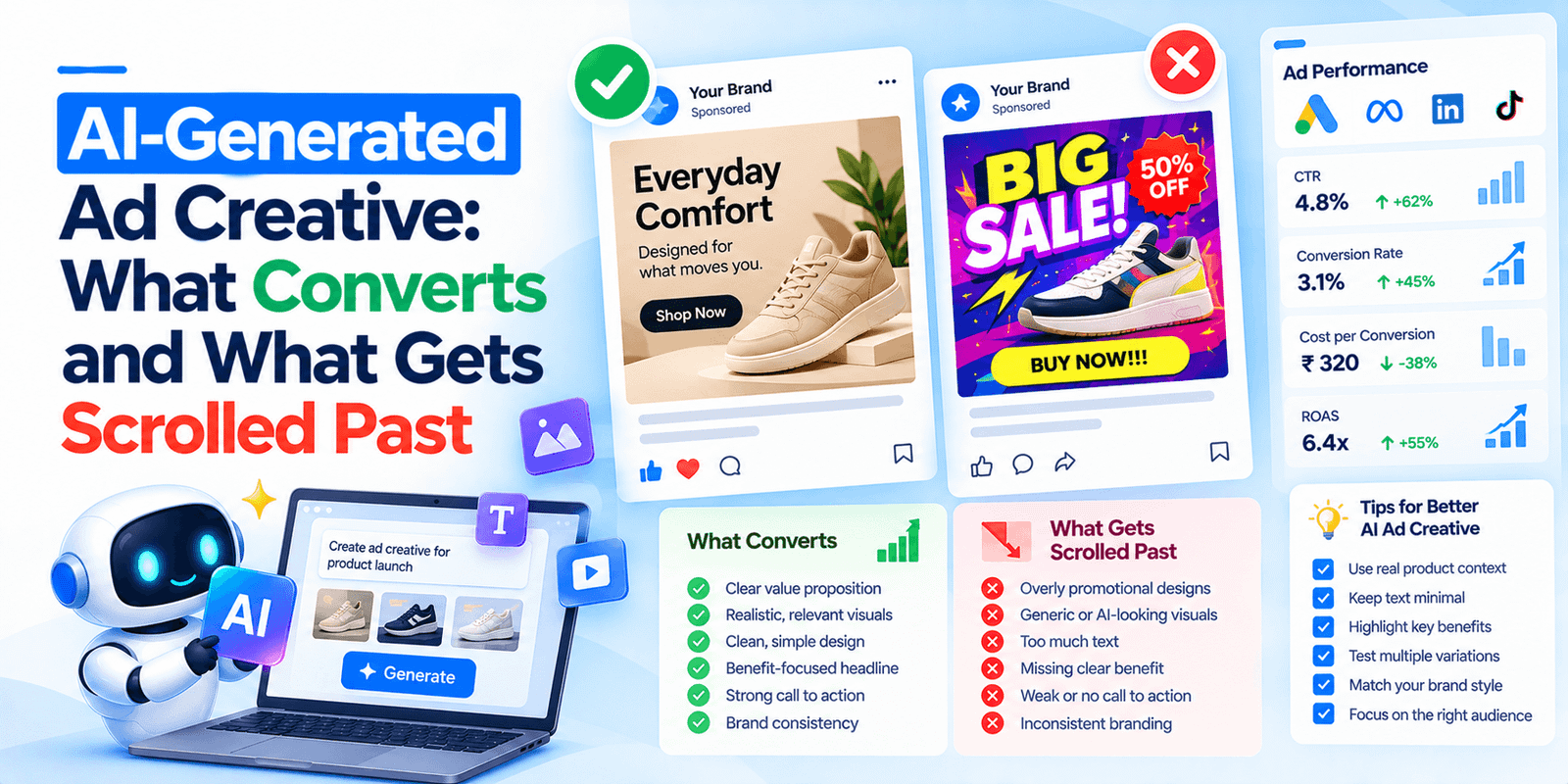
The best available research on AI-generated ads found that consumers rate them about the same as human-made ads on nine of eleven effectiveness measures. What they penalise is ads they believe are AI-made — and that penalty applies on every measure, whether or not the belief is correct.
So the problem with AI ad creative is not that it performs worse. It is that looking like AI costs you, and consumers are only slightly better than a coin flip at telling. Here is what that means practically, plus a platform-level reason why the most common way of using AI creative does not work at all. Current as of October 2026.
What did the research actually find?
The study worth knowing is by Mengyao Huang and Zsolt Katona at Berkeley’s Haas School of Business, dated June 2025. It is a faculty paper rather than a publication in a named journal, so treat it as strong evidence rather than settled science.
They built 438 human-made and 438 AI-generated ads across five categories — beauty, restaurants and fast food, cars, beverages, and clothing — and had roughly two thousand US respondents rate them on eleven effectiveness attributes without being told which was which.
Two findings, and the second is the one that matters.
On true origin, the authors report that with a few exceptions human and AI ads do not score significantly differently, and that only creativity and memorability show higher mean scores for human-made ads.
On perceived origin, they report that ads judged to be human-created score significantly higher on all dimensions regardless of their true nature. Their abstract puts it plainly: ads perceived as human-made receive significantly higher ratings across every effectiveness metric even when they are AI-generated.
The gap between those two effects is the practical finding. The real quality difference is small and confined to two attributes. The perception penalty is broad and applies to everything.
Can consumers actually tell?
This is the part that should change how you think about the risk.
Across product categories, correct identification ranged from 57% to 68%, with an overall mean of 64% — which the authors describe as not much better than random guessing. In the more realistic test, where people rated a single ad rather than choosing between a pair, accuracy sat around 58% to 60%.
Reported confidence did not correlate strongly with correctness. People who were sure were not more right.
One useful detail on what gives it away: respondents who cited photorealism and image colours as their reason were more accurate, while those who cited attractiveness and creativity did worse. People’s intuitions about which ads look AI-made are largely wrong, except when they are looking at rendering quality.
Which features make an ad look AI-made?
The authors ran a visual attribution analysis and found three things most associated with an ad being perceived as AI-generated: text, logos, and depictions of people.
That is actionable, and it maps onto what anyone who has used image generators already suspects. Rendered text is where models still fail visibly. Logos get mangled. Hands, faces and body proportions are where the uncanny quality shows.
So the practical rule is not to avoid AI images. It is to avoid asking AI to render the three things it gives itself away on. Generate backgrounds, scenes, product environments and textures. Composite your real logo and your real typography on top. If a human appears, that is the element to scrutinise hardest or shoot properly.
It is also worth noting a contrasting result the authors cite: a separate 2025 paper by Exner and Hartmann found AI-generated ads outperforming human-made ones, but only when the ads did not contain features that make them look like AI. Two independent findings pointing the same direction — the tells are the problem, not the technology.
Why does mass-producing AI variants not work?
Here is the platform-level reason, and it is the thing most AI creative tools are selling against.
The main commercial pitch for AI creative is volume: generate fifty variations of your ad in an afternoon. Meta’s current ads retrieval system, Andromeda, specifically neutralises that.
Andromeda clusters visually similar ads and treats them as a single entity. Run ten variations of the same product shot with different headlines and they do not get ten chances at distribution — they get one. Meta now exposes a Creative Similarity reading in Ads Manager, and practitioner guidance clusters around keeping it below roughly 40%, with anything above 60% treated as a problem. Those thresholds come from agency testing rather than Meta documentation, so use them to compare your account against itself over time.
The implication is specific. Generating fifty cosmetic variants of one concept is now close to worthless, and that is exactly what AI image tools are best at. What the system rewards is conceptual diversity: different message, different format, different awareness stage, different person it is aimed at.
That is still a job AI can help with — but as a production accelerator for genuinely different concepts, not as a variant machine.
How should you actually use AI creative?
Five things, in the order I would do them.
Use AI for concepts you would not otherwise shoot. The honest value is testing an angle that was previously too expensive to try. Five genuinely different propositions across three formats gives you fifteen distinct creatives from one brief, and those will land in separate entity clusters because they differ structurally rather than cosmetically.
Composite rather than generate end-to-end. Real logo, real typography, real product photography where the product is the hero. Use generation for the environment around it. This directly addresses the three features the research identifies as giving ads away.
Scrutinise anything with a person in it. If a human is in the frame, that is where detection risk concentrates. Either get it right or use a real photograph.
Judge on hook rate before cost per acquisition. Three-second views divided by impressions tells you whether the opening works, which is what creative is for. A creative with a strong hook and mediocre CPA is often worth reworking rather than killing.
Expect most of them to fail. Practitioner guidance puts a normal creative hit rate around five to ten percent. That is the cost of the diversity the system now requires, and it is why production speed matters more than production polish.
What about disclosure?
Worth being clear about a limit of the research. Nobody in the Berkeley study was told an ad was AI-generated. The penalty measured is for ads people believed were AI-made, which is not the same as the effect of an explicit label.
So the study does not tell you what happens if you disclose. The authors themselves flag that a binary label could have a drastic impact, and they do not measure it. Platform labelling requirements change, so check current policy rather than assuming.
Two reasons to be careful with the 64% figure
First, the data was collected around late 2024, and the AI images were produced with open-source diffusion models of that period. Image models have improved considerably since. If consumers were near chance at detection then, they are plausibly worse now — which strengthens the practical conclusion while making the specific number stale.
Second, this was a survey, not a field test. Respondents rated ads; nobody bought anything. Ratings of memorability and action likelihood are not conversions. The study tells you about perception, not about ROAS.
The honest summary
AI-generated ad creative is not inherently less effective on most measures. What costs you is the ad looking AI-made, and the features that give it away are text, logos and people — all three of which you can simply not ask the model to produce.
The bigger mistake is using AI the way it is marketed. Fifty cosmetic variants of one concept collapse into one entity on Meta and earn one shot at distribution. Five genuinely different concepts earn five.
Use it to widen your range of ideas, not to multiply one.
Frequently asked questions
Do AI-generated ads perform worse than human-made ads?
Not on most measures. A Berkeley Haas study of 876 ads found no significant difference on nine of eleven effectiveness attributes, with human ads scoring higher only on creativity and memorability. The larger effect was that ads people believed were AI-made scored lower on every measure, whether or not that belief was correct.
Can people tell if an ad is AI-generated?
Barely. Detection accuracy averaged 64% across categories in forced-choice pairs and around 58% to 60% when rating single ads, against 50% for guessing. Stated confidence did not correlate strongly with being right. Note the data is from late 2024 and image models have improved since.
What makes an AI ad look obviously AI?
Text, logos and depictions of people — the three features the Berkeley study’s visual attribution analysis most associated with being perceived as AI-generated. The practical fix is to generate environments and backgrounds while compositing real logos, real typography and real product photography on top.
Should I generate lots of AI ad variations?
No, and this is the most common mistake. Meta’s Andromeda retrieval system clusters visually similar ads into a single entity, so fifty cosmetic variants of one concept get one shot at distribution rather than fifty. Use AI for conceptually distinct ideas instead.
Do I have to disclose that an ad is AI-generated?
Platform requirements change, so check current policy. Note that the research does not answer whether disclosure hurts: nobody in the Berkeley study was told an ad was AI-made, so it measured the penalty for belief rather than the effect of a label, and the authors flag that a label could behave quite differently.
Want to know whether your creative is working?
A free ad account audit covers your creative similarity reading, your hook and hold rates by creative, and whether your account structure is giving the system enough signal to learn from.
Get a free ad account audit. If your creative is fine and the problem is somewhere else, we will tell you where.