

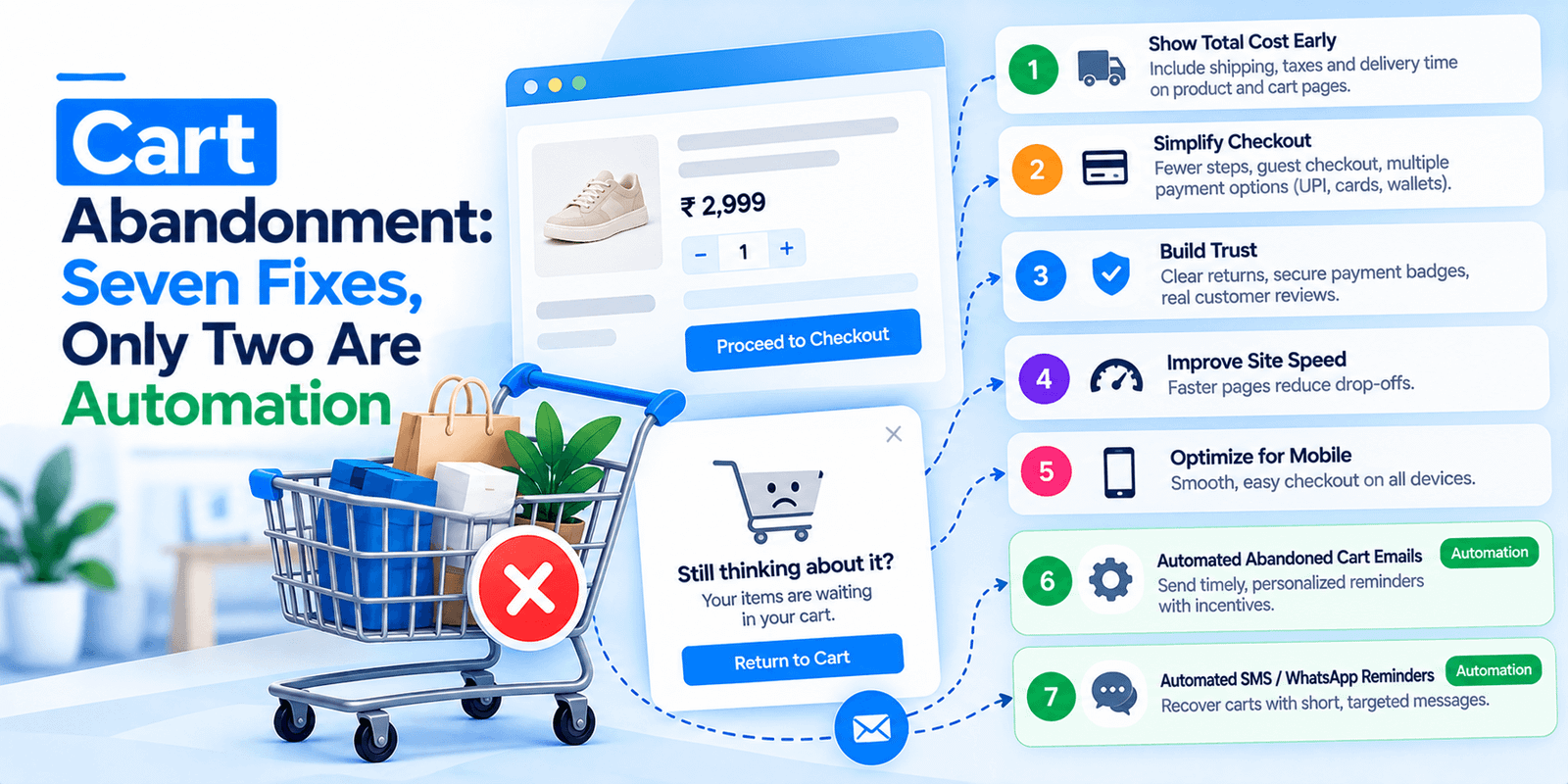
Before you buy an AI tool to recover abandoned carts, two numbers from the best independent research on the subject. Forty-two percent of US online shoppers who abandoned a cart say they were just browsing and not ready to buy. Of those who did intend to buy, the single biggest reason they left was that the extra costs — shipping, tax, fees — were too high.
Neither of those is an AI problem. This post covers the seven fixes that actually reduce cart abandonment, which two of them involve automation, and why the research house that has spent thirteen years studying checkouts does not mention AI once. Current as of October 2026.
Why do people actually abandon carts?
Baymard Institute is the reference source here, and worth distinguishing from the rest of this field: it is an independent research house, not a company selling cart recovery software.
Its survey of US online shoppers separates the browsers from the blocked buyers, which almost nobody repeating these statistics does. Forty-two percent abandoned because they were just browsing or not ready to buy. Baymard’s own assessment of that group is blunt: these are largely unavoidable, and almost impossible to reduce through better checkout design, because most will abandon before they even start checkout.
Setting that group aside, here is what the rest said:
Reason given | Share of shoppers | Does automation fix it? |
|---|---|---|
Extra costs too high (shipping, tax, fees) | 40% | No — pricing and transparency |
Delivery was too slow | 20% | No — logistics |
Didn’t trust the site with card details | 19% | No — design and trust signals |
Site wanted them to create an account | 18% | No — one setting |
Checkout too long or complicated | 17% | No — form design |
Website had errors or crashed | 17% | No — engineering |
Returns policy unsatisfactory | 13% | No — policy and placement |
Couldn’t see total cost up front | 12% | No — display |
Card was declined | 10% | Yes — retry logic |
Not enough payment methods | 9% | Partly — configuration |
Don’t know | 7% | — |
One precision note, because this statistic is routinely mangled: those are percentages of US online shoppers who gave each reason, and respondents could select more than one. They are not percentages of abandoned carts.
Read the list and the pattern is hard to miss. The top causes are pricing transparency, delivery, trust, and checkout friction. Not personalisation. Not timing. Not messaging.
What does Baymard say the fix is?
This is the part that should inform your spending.
After thirteen years of checkout testing, Baymard’s position is that the design and flow of the checkout process is frequently the sole cause of abandonments, and that many of these issues can be fixed purely through design changes. Its estimate is that the average large e-commerce site can gain a 35.26% increase in conversion rate through better checkout design alone.
It also notes that most of the changes in its report concern page layout, simple form features and improved microcopy, and therefore do not require advanced technical implementation or deep pockets.
Across the two Baymard pages covering this research, there is no mention of AI, personalisation, chatbots, email recovery or automation as remedies. Not as criticism of them — they simply are not what the research points to.
A caveat on the famous 70% figure
You will see cart abandonment quoted at around 70% everywhere, including in this post’s source. It is worth knowing what that number is.
Baymard’s 70.22% is an average it calculated across 50 different third-party studies published between 2006 and 2025. It is not Baymard’s own measurement. Several of the studies in that set were published by email, remarketing and marketing-automation vendors — the same companies that sell cart recovery.
Baymard is transparent about this, and the figure is still the best available benchmark. But treat it as a rough industry average assembled from uneven methods, and do not benchmark your own store against it too seriously. Your number depends enormously on whether you count add-to-carts from browsing traffic.
The seven fixes, in order of expected return
Mapped against the reasons above rather than against what is easiest to sell.
One. Show total cost early, including shipping. This addresses the largest reason by some distance, and the separate 12% who said they could not calculate the total up front. A shipping calculator on the cart page, or free shipping with the threshold stated before checkout. No automation required.
Two. Offer guest checkout. Eighteen percent abandoned because the site demanded an account. This is a single setting on most platforms and it is still the most common unforced error in e-commerce.
Three. Cut your form fields. Baymard found the average US checkout shows 23.48 form elements, that an ideal flow can be as few as 12 to 14, and that most checkouts can reduce their default count by 20% to 60%. This is tedious work with a measurable payoff and no licence fee.
Four. Fix trust signals at the payment step. Nineteen percent did not trust the site with their card. Security badges adjacent to the card fields, a visible returns policy, real contact details, and a checkout that does not look visually different from the rest of your store.
Five. Make the returns policy visible before checkout. Thirteen percent left over returns. If your policy is good, saying so earlier is free conversion. If it is bad, that is a business decision rather than a marketing one.
Six. Add payment methods and reduce declines. Nine percent wanted other payment options and 10% had a card declined. Wallet options and a retry flow that does not dump the customer back to an empty cart.
Seven. Fix the errors. Seventeen percent abandoned because the site broke. This is where site speed and stability genuinely belong in a conversion conversation, and it is measurable in your own data rather than inferred from a survey.
Where does automation actually earn its place?
Two of the seven, and both narrower than they are usually sold.
Abandoned cart email and SMS sequences. These do work, in the sense that a reminder to someone who left a full cart recovers some orders that would otherwise be lost. Worth being clear-eyed about the evidence: essentially every published recovery-rate figure comes from the platforms selling the sequences, and the independent research house does not measure them at all. So run them — they are cheap and the logic is sound — but set your own baseline and measure your own recovery rate rather than believing a vendor’s benchmark.
One practical note: the 42% who were just browsing are also the people most likely to receive these emails, which is part of why reported recovery rates look impressive. Recovering a browser who was never going to buy and recovering a blocked buyer are different events with the same label.
Decline recovery and payment retry logic. Ten percent of abandonment is a declined card, and automated retry with an alternative method is genuinely automation doing something a human cannot do at scale. This is the most underrated item on the list and the one most stores have not configured.
Where does AI specifically help, as of October 2026?
Three honest applications, none of which is a cart recovery product.
Making your checkout machine-readable for shopping agents. If AI shopping agents are going to complete purchases on your store, your product data, pricing and availability need to be structured and accurate. That is adjacent to abandonment rather than a fix for it, but it is where the real 2026 work is.
Finding your own abandonment reasons. The Baymard list tells you what US shoppers say in aggregate. Your store’s reasons are in your own session recordings, support tickets and checkout funnel data. Using AI to summarise a few hundred support conversations and surface the recurring complaint is a legitimate and cheap use of the technology.
Writing and testing checkout microcopy at volume. Baymard specifically names microcopy as a lever. Generating and testing variants is a reasonable thing to automate.
What should you do this week?
Open your own checkout on a phone, as a new customer, and count the form elements. If it is above twenty, that is your first project.
Then check three things: whether shipping cost is visible before the final step, whether guest checkout is available, and whether a declined card leaves the customer with a usable retry path. Those three cover the largest reasons on the list and none of them requires buying anything.
Only then look at the recovery sequence, and when you do, measure it against your own before-and-after rather than a vendor’s benchmark.
The honest summary
Cart abandonment is mostly a pricing-transparency and checkout-design problem, and the best independent research on it points entirely at design rather than technology. Two automations earn their place — recovery sequences and payment retry — and both should be measured against your own baseline because the published figures come from the companies selling them.
If you are choosing between a cart recovery subscription and a week spent cutting your checkout from twenty-three fields to fourteen, the research says do the second one first.
Frequently asked questions
Can AI reduce cart abandonment?
Only narrowly. Baymard Institute’s research finds the main causes are shipping and fee costs, slow delivery, trust, forced account creation and checkout complexity — none of which AI addresses. The two automations that genuinely help are recovery email sequences and automated payment retry after a declined card.
What is the number one reason for cart abandonment?
Among shoppers who intended to buy, extra costs — shipping, tax and fees — at 40%. Separately, 42% of US online shoppers who abandoned said they were simply browsing and not ready to buy, a group Baymard describes as almost impossible to convert through checkout changes.
Is the 70% cart abandonment rate accurate?
It is the best available benchmark but it is not a measurement. Baymard’s 70.22% is an average calculated across 50 third-party studies published between 2006 and 2025, several of them by email and remarketing vendors. Your own rate depends heavily on how much browsing traffic reaches your cart.
Do abandoned cart emails work?
They recover some orders and they are cheap to run, so yes. But every published recovery-rate figure comes from the platforms selling them, and the independent research does not measure them at all. Set your own baseline and judge against that rather than a vendor benchmark.
How many fields should a checkout have?
Baymard found the average US checkout displays 23.48 form elements, that an ideal flow can run to as few as 12 to 14, and that most checkouts can cut their default count by 20% to 60%. Counting your own is the cheapest diagnostic available.
Want to know what your checkout is actually losing?
A store readiness check looks at your checkout flow, counts the friction, tests whether a shopping agent can read your product data, and tells you which of the seven fixes above would move your numbers most.
Get a store readiness check. If your checkout is already clean, we will tell you that and look at what else is costing you orders.