
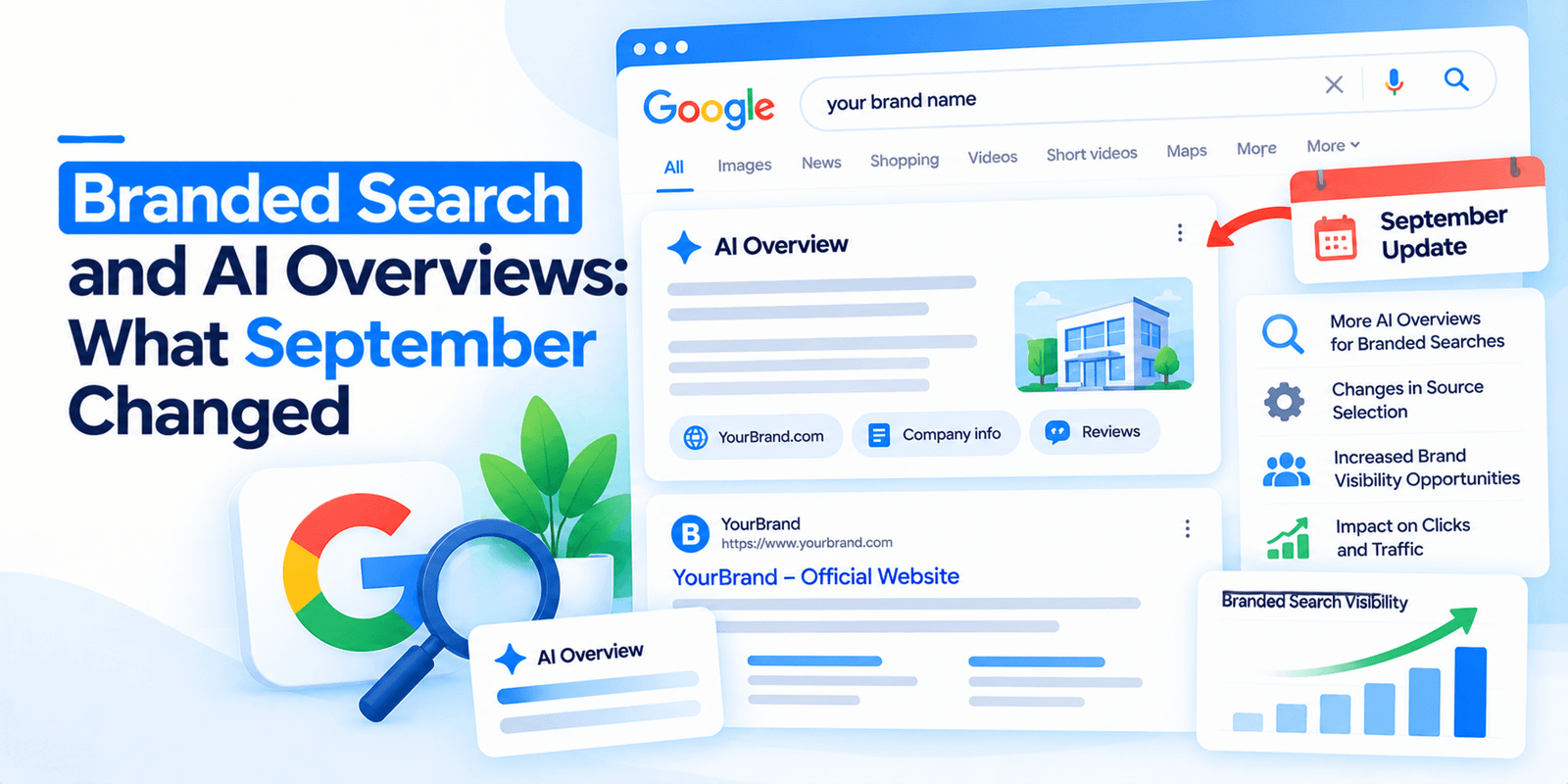
In September 2026, Google started showing AI Overviews on most searches for brand names. Two independent trackers agree it ended the month above 80%. They disagree substantially about where it started, nobody has measured what it costs in clicks, and neither measured whether the brands themselves are even cited in the overviews appearing on their own names.
That is the honest state of the most consequential change in AI search this year. Here is what is known, what is not, and why the standard advice about branded search just expired.
What actually happened in September?
DemandSphere, which runs a daily SERP tracker, published the series that started the story. On 1 September 2026, 26.12% of the branded keywords it tracks returned an AI Overview. On 29 September, the last day in its data, the figure was 82.06%, having peaked at 90.48% on 27 September. DemandSphere’s framing is that AI Overviews more than tripled on branded queries in a month.
Ahrefs looked at the same question on US desktop results and found AI Overviews on 65.1% of branded keywords in August, rising to 82.91% on 29 September.
Tracker | Scope | Baseline | 29 September | Implied change |
|---|---|---|---|---|
DemandSphere | All markets, all devices; keyword count not disclosed | 26.12% (1 Sep) | 82.06% | Roughly tripled |
Ahrefs | US desktop only | 65.1% (August) | 82.91% | Up about 18 points |
Both trackers agree the rate finished September above 80%. On the size of the change they do not agree at all. DemandSphere describes a jump from roughly a quarter of branded queries to four-fifths. Ahrefs describes a rise from about two-thirds to just over four-fifths. One is a tripling; the other is a substantial but much less dramatic increase from an already-high base.
The difference probably comes down to scope. Ahrefs measured US desktop only. DemandSphere measured all markets and all devices, and has not disclosed how many keywords it tracks or how it defines a branded query.
Google has not announced any change.
Why is “tripled” the number to be careful with?
The tripling figure is the one being repeated across the industry, and it rests on the weaker of the two datasets.
DemandSphere’s daily series is volatile in a way that matters.
Date (2026) | Share of branded keywords with an AI Overview |
|---|---|
1–5 September | 26.1% – 27.3% (steady) |
6–17 September | 28.6% – 35.5% (slightly elevated, stable) |
18 September | 57.43% |
19 September | 31.15% |
20 September | 46.62% |
21 September | 28.59% |
23 September | 56.97% |
25 September | 29.98% |
26 September | 69.21% |
27 September | 90.48% (peak) |
28 September | 80.23% |
29 September | 82.06% (last day in the data) |
The rate hit 57.43% on 18 September and was back to 31.15% the next day. It reached 46.62% on the 20th, then 28.59% on the 21st, then 56.97% on the 23rd, then 29.98% on the 25th. Only from 26 September do the high readings stop reverting, and the sustained period above 80% covers three days.
That pattern is what a staged rollout or a live test looks like. It is not a clean step change, and three days is a thin basis for calling it the new normal. DemandSphere’s post does not discuss the volatility, and it has not published a pre-September baseline, so the word “tripled” describes movement within one month rather than a trend.
None of this means the change is not real. Ahrefs independently found branded coverage above 80% at the end of September, and that is the part both datasets support. It means the magnitude is unsettled and the industry has standardised on the most dramatic available framing.
What has nobody measured?
This is where the coverage gets ahead of the evidence, and all three gaps matter more than the headline.
Nobody has measured clicks. Both trackers recorded whether an AI Overview appeared. Neither recorded what happened to click-through rates on branded queries afterwards. As of October 2026 there is no published data on what this change costs, or whether it costs anything.
Nobody has measured citation. This is the gap that should worry you most. DemandSphere was explicit that it counted an AI Overview as present whether or not the brand itself was cited in it. So we know Google is now generating an AI answer when someone searches your company name. We do not know how often that answer links to you.
Nobody has measured sentiment. Semrush, covering the data, put it plainly: what those AI Overviews actually say about the brands is a separate question. An AI-generated summary of your company, assembled from whatever the web says about you, is now the first thing a large share of people see when they search your name. Nobody has audited what those summaries contain.
Why did the standard advice about branded search just expire?
For the past two years the consensus has been that branded search is the safe harbour in AI search. Build your brand, get people searching your name, and you sidestep the AI Overview problem.
That advice rests largely on one study. In 2025, Amsive analysed roughly 700,000 keywords across ten websites and found that branded keywords with an AI Overview saw click-through rate rise by 18.7%, against declines for non-branded queries. It is a real finding and it was widely and correctly cited.
The problem is the condition it was measured under. In 2025, AI Overviews on branded queries were comparatively uncommon. A CTR benefit measured when overviews appeared on a minority of branded searches tells you very little about what happens when they appear on four-fifths of them. The sample of branded queries that triggered an overview in 2025 was, by definition, unusual.
So the finding has not been refuted. It has been overtaken. Anyone citing +18.7% in late 2026 as evidence that branded search is protected is quoting a measurement of conditions that no longer exist, and that includes anyone who wrote it into a content strategy earlier this year.
What actually matters now?
The goal has changed from avoiding AI Overviews on your branded queries to being properly represented inside them. You no longer get a choice about whether one appears.
There is useful evidence on what that is worth. Seer Interactive, analysing 3,119 queries across 42 organisations in late 2025, found organic click-through rate down 61% on queries with an AI Overview, but also found that brands cited in an overview earn around 35% more organic clicks than brands that are not. Citation is the variable you can still influence.
Practically, that reframes the work. The question is no longer how to keep Google from generating an answer about you. It is whether the answer Google generates names you, links to you, and says something accurate.
What should you check this week?
Four things, none of which require a tool subscription.
Search your own brand name, in an incognito window, on both mobile and desktop. See whether an AI Overview appears, read what it says about your business, and check whether your own site is among the sources. Do this for your top three competitors too.
Open Search Console, filter to queries containing your brand name, and compare September against August on clicks, impressions and CTR. You have this data and almost nobody looks at it this way. If impressions held and clicks fell, you are seeing the effect directly.
Check what your AI Overview is assembled from. If the sources cited are directory listings and third-party roundups rather than your own pages, that is a fixable problem and it is the same work as getting cited for non-branded queries.
Look for factual errors about your business in the overview. Wrong hours, wrong services, wrong service area, a competitor described as an alternative. These propagate from whatever the web says about you, and correcting the underlying sources is the only remedy.
The honest state of play
What is well supported: AI Overviews appeared on more than 80% of branded queries at the end of September 2026, per two independent trackers, and Google did not announce it.
What is contested: how big the increase was. DemandSphere says roughly a tripling; Ahrefs’ data implies a far smaller rise from a higher base.
What is unknown: whether this costs clicks, how often brands are cited in the overviews on their own names, and what those overviews say.
The strategic conclusion most people are reaching, which is to invest in brand, is probably still correct. But it is correct for a different reason than the one being given. Not because branded queries are immune, which looks increasingly untrue, but because a strong, well-documented, widely-referenced brand is what makes an AI system describe you accurately and cite you when it does.
Frequently asked questions
Do AI Overviews now appear on branded searches?
Usually, yes. Two independent trackers found AI Overviews on more than 80% of branded keywords at the end of September 2026 — DemandSphere at 82.06% across all markets and devices, Ahrefs at 82.91% on US desktop. Google has not announced the change and has not said whether the rollout is finished.
Do AI Overviews hurt branded search traffic?
Nobody knows yet. Both September trackers measured only whether an overview appeared, not what happened to clicks. The most-cited evidence that branded queries benefit — Amsive’s +18.7% CTR finding — dates from 2025, when overviews on branded queries were far less common, so it does not describe current conditions.
Does an AI Overview on my brand name link to my website?
Not necessarily, and this is the important unanswered question. DemandSphere counted an overview as present whether or not the brand was cited in it. Search your own name and check the sources listed. Seer Interactive found cited brands earn roughly 35% more organic clicks than uncited ones.
What can I do about what an AI Overview says about my business?
Fix the sources it draws from. AI Overviews assemble from what the web says about you, so inaccurate hours, services or service areas usually trace back to directory listings, old pages or third-party write-ups. Correcting those, and making your own pages the clearest source, is the available remedy.
Want the next one of these?
We read the primary sources on this stuff so you do not have to, and we say when the data does not support the headline.
Join the newsletter for a weekly note on what changed in AI search and what it actually means. No pitch, and you can leave whenever you like.