

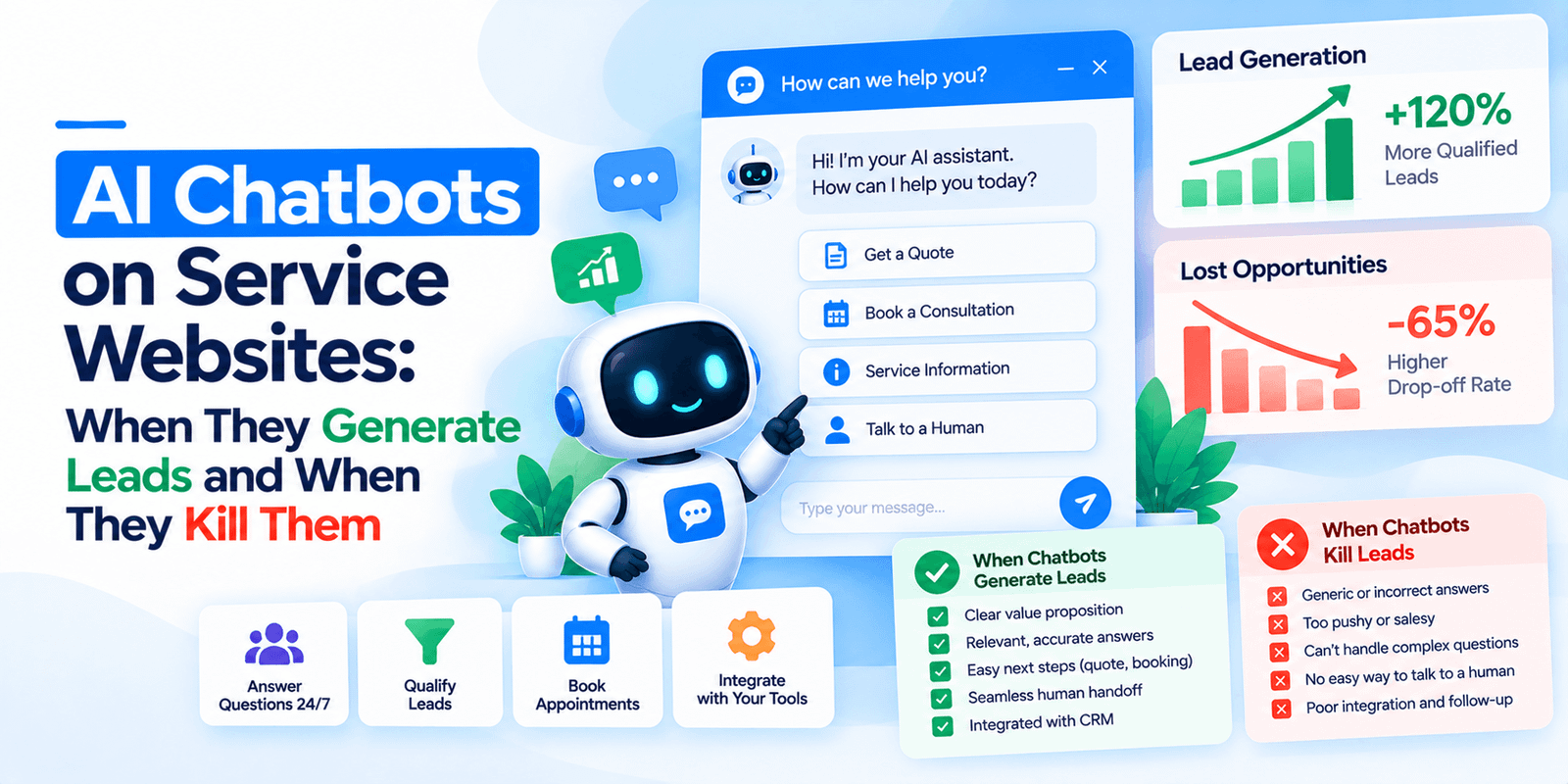
A chatbot on a service website generates leads when it answers questions a visitor would otherwise have to phone to ask, and it kills leads when it stands between a ready-to-buy visitor and a human being. The difference is not the software. It is whether the bot is sitting on the path of people who were already going to convert.
Most of the statistics you will find on this question come from companies that sell chatbots. Here is what the independent research actually shows, as of October 2026.
Do chatbots generate leads, or just intercept them?
Start with the uncomfortable possibility. A visitor on your contact page who was about to fill in the form instead opens the chat widget, asks one question, gets a partial answer, and leaves. Your chat tool records an engagement. Your form records nothing. The lead is gone and your dashboard looks busier than it did before.
This is the central measurement problem with website chatbots, and it is why vendor-reported engagement figures are close to worthless for deciding whether to install one. Engagement is not incremental. The question is whether total enquiries went up, and almost nobody measures it that way.
The honest version of the question: does the bot capture people who would have left, or does it divert people who would have converted?
What does the best study on this actually show?
The strongest evidence available is a randomised field experiment published in Marketing Science in 2019 by Xueming Luo, Siliang Tong, Zheng Fang and Zhe Qu. It covered more than 6,200 customers of a financial services company, randomly assigned to receive sales calls from either a chatbot or a human agent, with the bot’s identity disclosed at different points or not at all.
Two findings, and the second is the one everybody skips.
First, disclosing up front that the agent was a bot cut purchase rates by 79.7%, from 23.7% to 4.8%. More than half the customers in that group hung up within five seconds of hearing it.
Second, and this is the part that matters: the undisclosed chatbot converted at 23.7%, which was statistically indistinguishable from the top 20% of human agents at 25.1%. The bottom 20% of human agents converted at 4.9%. The researchers mined the call recordings and found the bot was objectively as knowledgeable and as empathetic as the best human agents. The authors describe the disclosure penalty as a subjective human perception against machines despite the objective competence of the system.
So the technology worked. What failed was how people reacted to being told about it.
Why does that 79.7% figure probably not apply to you?
It is a real number from a real experiment and it is almost certainly not your number. Three reasons.
The study ran in 2019 on outbound sales calls to existing loan customers in China, in Mandarin, during a 24-hour promotion. Outbound calls are a different proposition from a website visitor who chose to open a chat window. Someone who clicks your chat widget has already opted in.
It predates large language models. The paper is careful to say its bot was not a simple rule-based system, but it was still a scripted voice agent from seven years ago.
Most importantly, the paper’s own analysis found that customers with prior experience of AI applications penalised the disclosure significantly less. In 2019 that was a minority of people. By late 2026, after three years of mainstream chatbot use, it is most of your visitors.
That last point is an inference from the paper’s moderator analysis rather than a finding the authors state about 2026, and I will not dress it up as more than that. But the direction is clear, and it means the correct response to this research is not the one it superficially suggests.
To be explicit, because the finding invites a bad idea: the study measured what happens when a company hides a bot. That is not a strategy to copy. It is deceptive, it damages trust the moment anyone notices, and as covered below it carries legal exposure. The useful reading is that competence, not humanity, is what the bot has to deliver.
When does a chatbot generate leads?
Four situations where a chatbot reliably adds enquiries rather than redistributing them.
After hours. A home services company getting enquiries at 11pm has a real choice between a bot capturing a name, a number and a problem description, and an unanswered contact form. The bot wins that comparison easily. This is the single strongest case for installing one.
Questions that gate the enquiry. Do you take my insurance. Do you serve my zip code. How much does a consultation cost. Do you work on this make of car. These are the questions people need answered before they are willing to call, and a bot that answers them accurately converts browsers into callers. Note that a well-built FAQ page does much of this too, and costs nothing to run.
Booking, where booking is the conversion. If the desired action is an appointment and the bot can actually place one in your calendar, it shortens a multi-step process to one conversation. If it can only tell someone to call to book, it has added a step rather than removing one.
High-volume repetitive triage. If your front desk spends its day answering the same six questions, a bot deflecting those is a staffing win regardless of its lead-generation effect.
When does a chatbot kill leads?
Five failure modes, in rough order of how often they do damage.
It occupies the conversion path. A widget that opens automatically on your contact page, or covers the phone number on mobile, is competing with your own call to action. If you install nothing else from this article, check what your chat widget does on a phone.
It cannot escalate. The fastest way to lose a ready buyer is to make them repeat themselves to a human after the bot failed. Every bot needs a visible, one-click route to a person, and on a service site that route should appear early rather than after three failed exchanges.
It answers regulated questions. A bot on a law firm or clinic site that offers anything resembling legal or medical advice is a liability, not a lead source. These bots need hard boundaries and a scripted refusal, and most off-the-shelf installations do not have them.
It is confidently wrong about your business. An LLM-based bot given a thin knowledge base will invent your pricing, your hours and your service area. This is where the legal exposure lives.
It replaces something that was working. If your form converts and your phone rings, adding a bot in front of both is a change with downside risk and no measurement plan. Test it, do not assume it.
Situation on your site | Likely effect of adding a chatbot |
|---|---|
Enquiries arrive outside business hours and go unanswered | Adds leads — strongest case |
Visitors ask gating questions before calling (insurance, coverage area, price) | Adds leads if answers are accurate |
Bot can book directly into your calendar | Adds leads — removes a step |
Widget auto-opens on the contact page | Costs leads — competes with your form |
Widget covers the phone number on mobile | Costs leads — check this today |
No one-click route to a human | Costs leads — loses ready buyers |
Regulated advice territory (legal, medical) with no hard limits | Liability, not a lead source |
Thin knowledge base, LLM-powered | Invents answers — see the Air Canada case |
What is the legal exposure, and is it the one you think?
Two things here, and the one most people worry about is not the one that should concern them.
The compliance worry is usually misplaced. California’s B.O.T. Act, from SB 1001, is the best-known US bot disclosure law and it is much narrower than the compliance content online implies. Per a 2019 analysis by Faegre Drinker in the National Law Review, it applies to bots used to incentivize a sale or transaction, or to influence a vote, in communications with people in California, and only to public-facing sites, apps or networks with at least 10 million monthly US visitors or users. A dental clinic or a law firm site is nowhere near that threshold. It is enforced by the Attorney General and carries no private right of action. That analysis is seven years old and does not list the codified sections, so confirm the current text with counsel rather than treating this paragraph as advice.
The real exposure is what the bot says. In February 2024 the British Columbia Civil Resolution Tribunal found Air Canada liable for a bereavement fare discount its chatbot described but its actual policy did not offer. Air Canada argued, among other things, that the chatbot was a separate legal entity responsible for its own actions. The tribunal rejected that, finding the chatbot was part of Air Canada’s website and the company was responsible for the information on it regardless of whether it came from a static page or a bot. The damages were about CAD 650.
Two honest caveats. This is a Canadian tribunal decision, not a court ruling, and the American Bar Association’s own write-up notes that. It does not bind a US court. But the principle it applied is the one any business should plan around, because no company has ever successfully argued it is not responsible for what its own website says. Size offers no protection here: the disclosure law has a ten-million-visitor floor, and liability for a wrong answer does not.
How should you decide?
Four questions, in order.
Where would it sit, and what is already converting there? If the answer is your contact page, be careful. If the answer is deep service pages where visitors currently have no next step, that is a better case.
What happens at 11pm now? If the answer is nothing, a bot has obvious upside.
Can it book, or only talk? Booking capability roughly doubles the value.
How will you know if it worked? Decide this before installing. The metric is total enquiries from all channels, compared against the equivalent period before. Not chat engagements, not conversations started.
If you cannot answer the fourth question, do not install one yet.
What should you do if you already have one?
Open your site on a phone and check whether the widget covers your phone number or your form. Ask it three questions a real customer would ask, including a price question, and see whether the answers are correct. Try to reach a human in one click. Then look at whether total enquiries rose after it was installed, which most businesses have never checked.
Frequently asked questions
Do chatbots increase conversion rates on service websites?
Sometimes, and the published figures are unreliable because most come from chatbot vendors measuring engagement rather than incremental enquiries. A bot adds leads when it captures after-hours traffic or answers questions that gate a phone call. It costs leads when it sits on a conversion path that was already working.
Do I legally have to disclose that my website chatbot is AI?
Probably not under California’s B.O.T. Act, which per a 2019 legal analysis reaches only sites with at least 10 million monthly US visitors, and only bots used to incentivize a transaction or influence a vote. Rules vary by state and the EU is stricter, so check with counsel. Disclose anyway — the trust cost of being caught exceeds the conversion cost of being honest.
Can my business be held liable for what its chatbot says?
Treat it as yes. A Canadian tribunal held Air Canada responsible in February 2024 for a discount its chatbot invented, rejecting the argument that the bot was a separate entity. That decision does not bind US courts, but no business has successfully disclaimed its own website’s statements, and the reasoning is what to plan around.
Is a chatbot better than a contact form for a small service business?
Not better — different. Forms work for people willing to wait; bots work for people who want an answer now, and for hours when nobody is there. The failure case is putting a bot in front of a form that already converts, then measuring chat engagements instead of total enquiries and concluding it worked.
Want us to test yours?
A free UX review includes exactly that: we open your site on mobile, run your chatbot through the questions your customers actually ask, check whether it is helping or sitting in the way, and tell you which it is.
Book a free UX review. If the bot is costing you enquiries, we will show you where.