

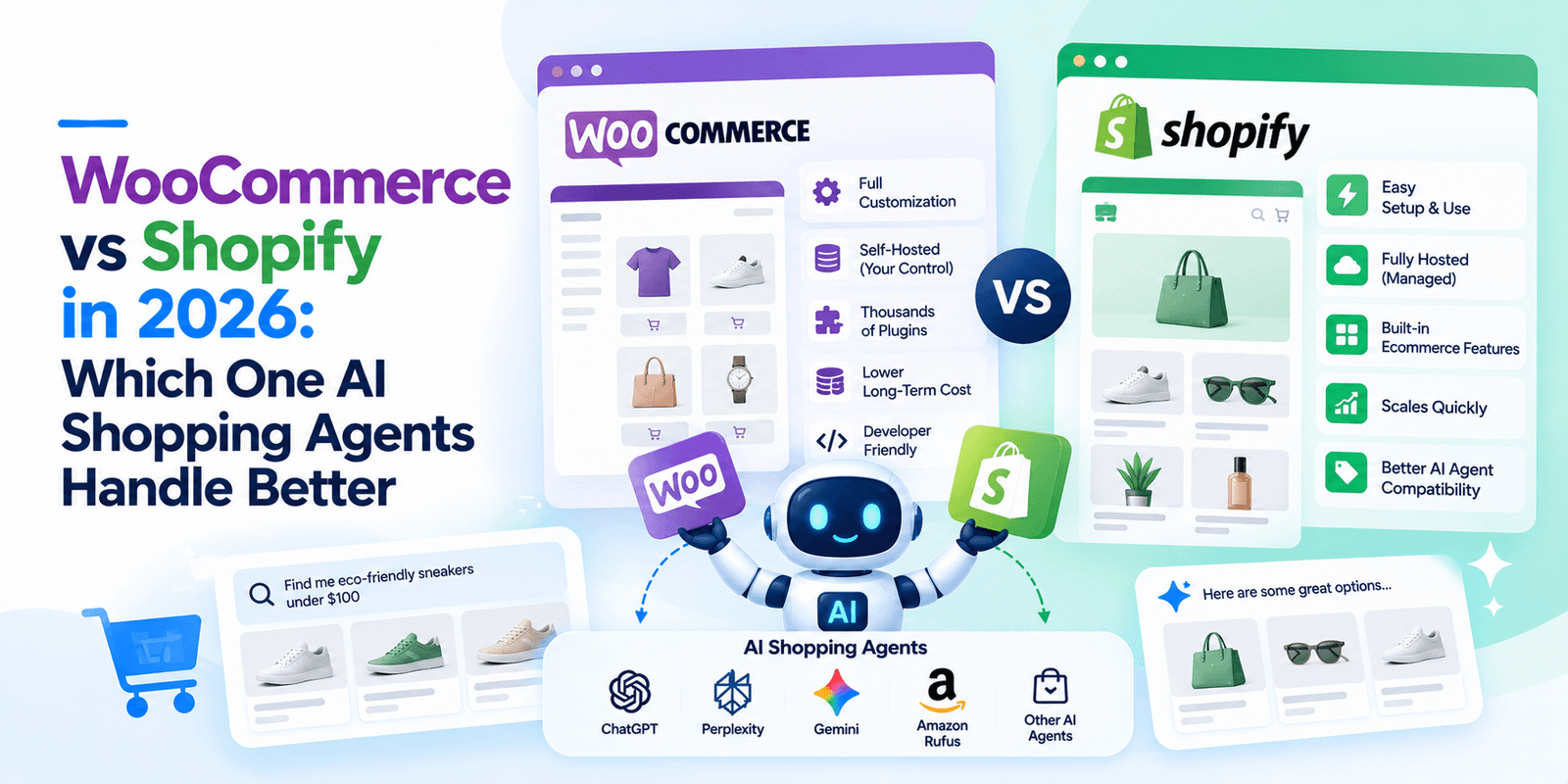
As of October 2026, if your question is whether an AI shopping agent can find your product and complete a purchase, Shopify has shipped a path and WooCommerce has a waitlist. That is the short answer. The longer answer is that this probably should not be the reason you choose a platform, and the two companies are not actually competing on the same thing.
Here is what each has built, where the claims stop matching the documentation, and how to decide.
What do AI shopping agents actually need from a store?
Strip away the protocol names and an agent needs three things. It needs to find your products in a structured feed it trusts. It needs accurate price and inventory data at the moment it looks. And it needs a way to complete a transaction without a human clicking through your checkout.
The first two are solvable on any platform. The third is where the platforms diverge, and it is the one that decides whether an agent recommends you or buys from you.
What has Shopify built?
Shopify’s position is distribution. In January 2026 the company announced that the Shopify Catalog is open to every brand through a new Agentic plan, including brands that do not use Shopify for their online store. The same announcement introduced the Universal Commerce Protocol, co-developed with Google, and described it as already endorsed by more than twenty retailers and platforms.
The practical mechanism is Agentic Storefronts, managed from the Shopify Admin. A merchant sets up product data once and Shopify pushes it to AI channels. ChatGPT is described as an existing channel. Microsoft Copilot Checkout was described as rolling out, with Keen and Pura Vida named as merchants using it.
Two honest caveats. Shopify’s announcement is nine months old and promotional, and some of its claims are forward-looking while written in the present tense. Native shopping on Google surfaces was described as rolling out soon rather than live, with Monos, Gymshark and Everlane named as brands that will soon sell in AI Mode and the Gemini app. Verify current status in the Shopify changelog before you treat any specific channel as switched on.
But the architecture is real and it points one direction: Shopify is making itself the layer between your catalog and every AI surface.
What has WooCommerce built, and why is it a different thing?
WooCommerce has shipped more AI tooling than most people realise. It is just aimed somewhere else.
WooCommerce documents an MCP integration that lets AI assistants interact with a store through the Model Context Protocol. Read the documentation closely and three things stand out. It is labelled a developer preview, with the note that implementation details and APIs may change. It is not bundled, so you install the separate WordPress MCP Adapter plugin to get a server. And it authenticates using a WordPress username and an Application Password.
That last detail is the whole story. An AI agent connecting to your store through this is logging in as a WordPress user with store-management permissions. The abilities exposed are querying, creating, updating and deleting products, plus updating order status and adding order notes. The documentation’s example clients are Claude Desktop, Claude Code, Cursor and VS Code.
This is a tool for you to manage your store with an AI assistant. It is not a way for a shopper’s agent to buy from you. The documentation does not mention shoppers, carts, checkout or any external buyer agent, because that is not what it is for.
Separately, WooCommerce published a Claude Commerce Agent in September 2026, adapted from Anthropic’s open-source starter code. It is worth looking at and it is explicitly not a product. WooCommerce’s own post says it is built for experimentation and growth and not maintained in an official capacity, that the bridge plugin is part of the reference rather than a supported extension, and that there is no authentication and no undo. It is scoped to small stores. And the shopper assistant never places an order or takes payment; it hands the cart to the normal WooCommerce checkout.
On transactions, WooCommerce announced in December 2025 that it was a launch partner for Stripe’s Agentic Commerce Suite, saying Woo merchants would be among the first to benefit when it rolled out in the coming months. Ten months later that page still points to a waitlist with no stated launch date.
What is the distinction almost nobody makes?
Shopper-side and merchant-side AI are different products, and the marketing for both uses the same words.
Merchant-side means you point an AI assistant at your own store to do your job faster — bulk-editing products, answering questions about your orders, drafting listing copy. WooCommerce is genuinely further along here, and if you are a developer or an agency running client stores, the MCP integration is useful today.
Shopper-side means someone else’s agent discovers your product in a conversation and completes a purchase. This is the one that affects revenue, and it requires your catalog to be inside a feed the agent reads and a checkout the agent can complete. Shopify has built that pipe. WooCommerce has announced intent to.
When you see a headline claiming a platform has Model Context Protocol support from the ground up, check which of these two it means. In the WooCommerce documentation, it means the merchant side.
Capability, as of October 2026 | Shopify | WooCommerce |
|---|---|---|
Products in a feed external AI agents read | Yes — Shopify Catalog | No equivalent first-party feed |
Agent-completable checkout | Yes on ChatGPT; Copilot Checkout rolling out | Announced via Stripe, waitlist only |
Google AI Mode / Gemini selling | Announced “soon”, not confirmed live | Not announced |
Protocol position | UCP co-author with Google | ACP via Stripe; MCP via WordPress |
Merchant-side AI store management | Admin tooling, less documented | MCP integration, developer preview |
Status of the shopper-side path | Shipped, verify per channel | Reference code and a waitlist |
Who controls the distribution | Shopify | You, if and when it ships |
So should you switch?
Probably not for this reason, and here is the uncomfortable part for everyone selling urgency about it.
Nobody has shown that meaningful sales volume is moving through AI shopping agents right now. WooCommerce commissioned an IDC InfoBrief published in July 2026 under the headline that AI agents are already shopping and most merchants are not ready. We read it. The figures in it are IDC forecasts for 2027 and 2030 — spending projections, predictions about enterprise agent adoption, and one number on digital leaders citing legacy platform rigidity as a barrier. There is no measurement of current agent shopping activity in it at all, and no stated sample or survey method. It is a forecast document presented as a readiness alarm.
That does not mean agentic commerce is nothing. It means the volume is ahead of us, not behind us, and a replatform is an expensive hedge against a market that has not arrived.
Replatforming to Shopify costs real money and real risk. If your business runs well on WooCommerce, the correct move in October 2026 is to get your product data clean and your feeds structured, then revisit when the Stripe path ships or when you can measure actual agent referrals in your analytics. If you are already evaluating a rebuild for other reasons — performance, your team’s capability, checkout conversion — then agent readiness is a legitimate thumb on the scale toward Shopify.
The lock-in question cuts the other way too. Shopify’s distribution advantage runs through Shopify’s catalog, Shopify’s admin and a protocol Shopify co-authored. That is convenient now and it is a dependency later. WooCommerce’s bet is that these protocols commoditize and owning your data layer wins. That is a bet, not a fact, and anyone presenting either position as settled is selling.
What should you do this quarter, on either platform?
Four things matter more than your platform choice and all four are portable.
Get your structured product data right. Complete Product schema with price, availability, GTIN or MPN, and specific attributes. Agents cannot recommend what they cannot parse, and this is the work that pays off on whichever platform you end up on.
Make inventory and pricing accurate in real time. An agent that surfaces an out-of-stock item once learns not to trust your feed.
Make your policies machine-readable. Shipping, returns and warranty on their own crawlable pages in plain text, not buried in an accordion or a PDF.
Start measuring. Set up referral tracking for AI sources now so you have a baseline before the volume arrives. You cannot judge whether this matters to your business without data from your business.
The verdict
For shopper-facing agentic commerce as of October 2026, Shopify is ahead and the gap is real. For merchant-side AI tooling, WooCommerce is arguably ahead. Neither gap is currently large enough to justify a replatform on its own, and both companies have a commercial interest in telling you otherwise.
Frequently asked questions
Can ChatGPT buy from my WooCommerce store today?
Not through a first-party WooCommerce integration. WooCommerce announced a Stripe Agentic Commerce Suite partnership in December 2025, but as of October 2026 that route is still a waitlist with no published launch date. A custom build on the Store API is possible but you would be maintaining it yourself.
Does WooCommerce have an MCP server?
Yes, but it is merchant-side and in developer preview. You install the separate WordPress MCP Adapter plugin, and agents authenticate as a WordPress user with an Application Password. It lets your own AI tools manage products and orders. It is not a channel for shoppers’ agents to purchase through.
Is Shopify’s agentic commerce available on every plan?
Shopify has not published plan-level eligibility for Agentic Storefront channels, and its January 2026 announcement did not state gates by plan, region or product category. The Agentic plan it introduced is aimed at brands without a Shopify storefront. Confirm your own eligibility in the Shopify Admin.
How much traffic are AI shopping agents actually sending?
Far less than the coverage suggests, and nobody has published credible platform-level figures. Set up AI referral tracking in your own analytics and measure it directly rather than relying on vendor forecasts, most of which project to 2027 and beyond rather than measuring today.
Is replatforming to Shopify worth it just for AI readiness?
On current evidence, no. The portable work — structured product data, accurate inventory, machine-readable policies — captures most of the available benefit on either platform. Replatform when you have other reasons, and let agent readiness be a tiebreaker rather than the case.
Not sure which applies to you?
We work on both platforms and we do not get paid more for recommending either. A platform consultation looks at your actual traffic, your product data quality and your conversion path, and tells you whether a rebuild is worth it or whether you are better off fixing what you have.
Book a platform consultation. If the answer is stay where you are, we will say so.