

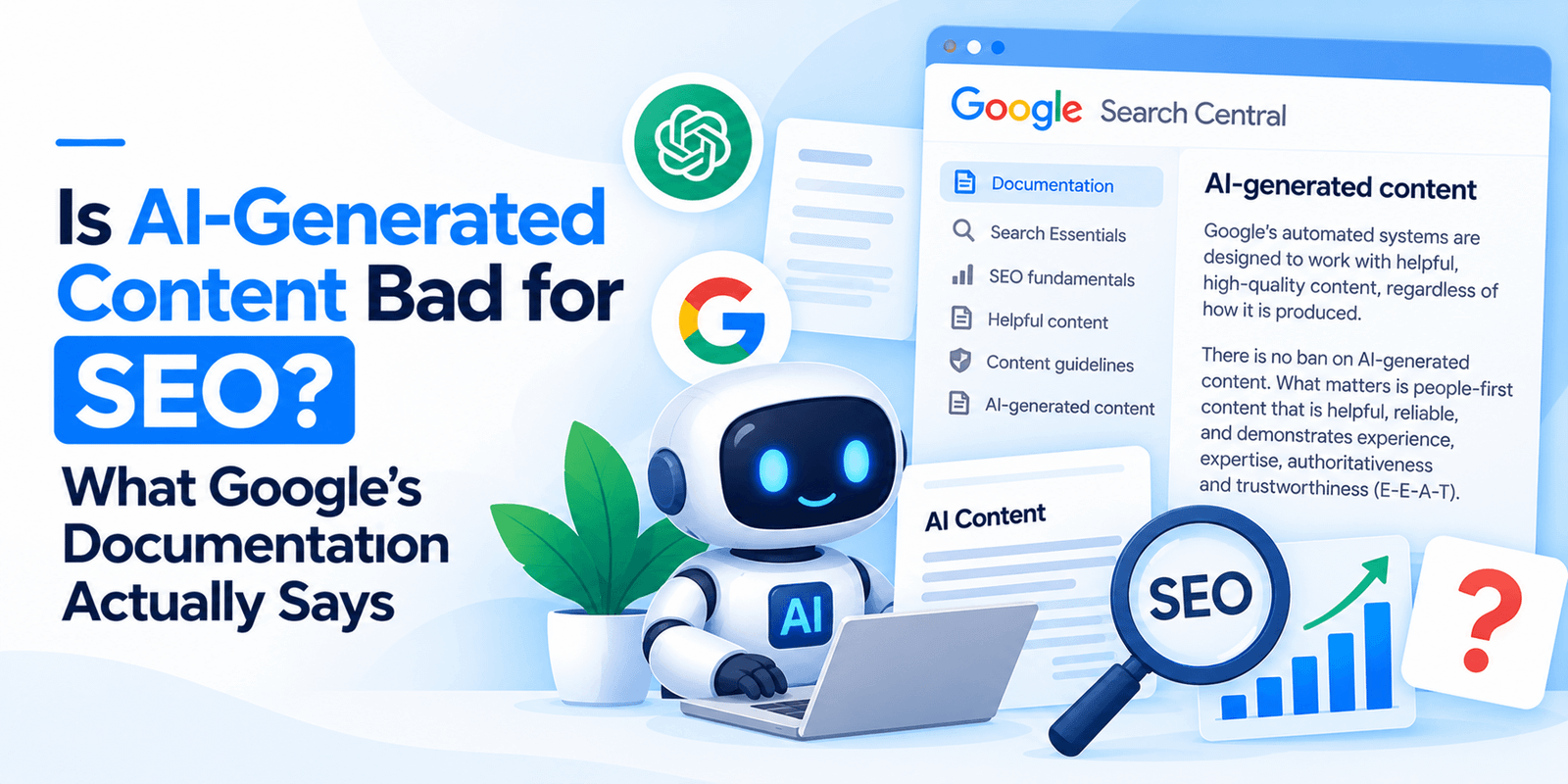
Is AI-generated content bad for SEO? No. Google’s documentation does not prohibit AI-generated content, and the relevant policy says so explicitly. What it penalises is content produced at scale to manipulate rankings rather than help anyone, and the policy applies to that content no matter who or what produced it. The practical test has three parts: purpose, effort, and whether you tell readers. Here is the actual wording, and what happened when somebody published 2,000 AI articles and watched them for sixteen months.
What does Google’s documentation actually say?
The relevant policy is called scaled content abuse. It sits in Google’s spam policies, last updated 28 August 2026, and it reads:
“Scaled content abuse is when many pages are generated for the primary purpose of manipulating search rankings and not helping users. This abusive practice is typically focused on creating large amounts of unoriginal content that provides little to no value to users, no matter how it’s created.”
That final clause is the one that settles the question. The policy is indifferent to production method. A thousand thin pages written by freelancers for two dollars each fall under it exactly as a thousand pages generated by a model do.
The policy does name AI directly, but only in a specific context. Among its listed examples is “using generative AI tools or other similar tools to generate many pages without adding value for users”. The operative words are many and without adding value, not generative AI.
One small correction while we are here. People often call this the “site reputation abuse” policy. Google’s documentation has no such heading. There is a separate Site reputation policy, and it concerns third-party content published on a host site mainly to borrow that host’s ranking signals. It has nothing to do with AI.
The three tests Google actually applies
Google’s guidance on creating helpful content, updated 5 October 2026, frames this as three questions: who, how and why. Read together with the spam policy, they give you a usable standard.
Purpose. The documentation is blunt: “If you use automation, including AI-generation, to produce content for the primary purpose of manipulating search rankings, that’s a violation of our spam policies.” It also describes “why” as “perhaps the most important question to answer about your content”, and says the answer should be that you are “creating content primarily to help people”.
Effort. This is where most AI content fails. Google’s wording: “automatically generating pages from feeds or using generative AI to produce large amounts of text without manual oversight or curation represents little to no effort.” Note what is being measured. Not whether a human typed it, but whether a human oversaw it.
Disclosure. The documentation says automated, AI-generated and AI-assisted content all have a “how” component, and asks whether “the use of automation, including AI-generation, [is] self-evident to visitors through disclosures or in other ways”. Its recommendation is measured: “AI or automation disclosures are useful for content where someone might think ‘How was this created?'” and you should “consider adding these when it would be reasonably expected.”
That is softer than a requirement and firmer than nothing. For a blog post explaining a topic, most readers do not ask. For a product review or a medical explainer, they might.
The line Google draws on authorship
One passage deserves particular attention, because it is where AI content tips from acceptable into penalised.
“Fabricating creator profiles (such as by using AI-generated headshots, made-up names, or false credentials to make content appear as if it was written by human experts) is a form of deception.”
So inventing an author is a problem. Having a real one is actively encouraged: the documentation says Google “strongly encourage[s] adding accurate authorship information, such as bylines to content where readers might expect it.”
That has a practical consequence worth acting on. If your blog is bylined with your company name or “admin”, you are not deceiving anyone, but you are also providing none of the signal Google says it looks for. The fix is a real named person with real credentials. The fix is not a plausible-sounding invented one.
What happened when somebody tested it
SE Ranking published 2,000 AI-generated articles across 20 brand-new domains in November 2024, one site per niche, a hundred articles each. The text went up as generated. No editing, no internal links, no images, no backlinks, no promotion. They then watched for sixteen months.
The trajectory is the interesting part.
Point in time | Impressions | Clicks | Note |
|---|---|---|---|
36 days | 122,102 | 244 | ~71% of pages indexed |
~2.5 months | 526,000+ | 782 | Peak momentum |
Feb 2025 | — | — | Pages ranking in the top 100 fell from 28% to 3% |
6 months | 706,000 | 1,062 | Growth largely stopped |
16 months | 1,092,079 | 1,381 | ~67% still indexed |
Indexing was never the problem — around 71% of pages were indexed within 36 days. Early visibility looked promising. Then it stopped. Roughly 70 to 75% of all the traffic those sites ever received arrived in the first two and a half months.
That final row is the one to sit with. A click-through rate of about 0.13% over sixteen months, from 2,000 articles. Not a penalty exactly. Just irrelevance at scale.
What that experiment does not prove
Three caveats, and they matter enough to state plainly.
There was no human-written control group. The experiment compared unedited AI content against nothing, so it cannot tell you how the same 2,000 topics would have performed written by people.
SE Ranking were testing their own AI writing tool and sell it. That does not make the numbers wrong, and to their credit the findings are unflattering, but it is a conflict worth naming.
Their own conclusion overstates their data. They describe the sites as seeing “no traffic or visibility for the year”, having just reported 1,381 clicks and over a million impressions. Small is not zero.
The same company also ran six AI-drafted, human-edited articles on their established blog. Those accumulated 555,000 impressions and 2,377 clicks, with three of six ranking in the top ten and four cited in AI Overviews. Encouraging, but confounded: an established authoritative domain is a very different starting position from a new one, as the authors themselves acknowledge.
So what is the actual answer?
AI-generated content is not bad for SEO. Unedited AI content published at volume to fill a keyword list is bad for SEO, and would be bad if humans wrote it that way too.
The working standard, drawn from Google’s own wording rather than from folklore:
- Have a reason for the page beyond ranking for something.
- Have a human who knows the subject edit it and verify every factual claim.
- Put a real named author on it, with credentials you could defend.
- Disclose AI involvement where a reader would reasonably wonder.
- Publish fewer pages than your tooling makes possible.
That last one is the hardest and the most important. The constraint that used to be enforced by the cost of writing now has to be enforced by judgement.
Not sure which side of the line your content sits on?
We will audit your existing content against Google’s actual criteria, flag the pages at risk, and tell you which ones are worth improving rather than deleting.
No charge, and the findings are yours either way.
Frequently Asked Questions
Is AI-generated content against Google’s guidelines?
No. Google’s scaled content abuse policy targets pages “generated for the primary purpose of manipulating search rankings and not helping users”, and states the policy applies “no matter how it’s created”. Production method is not the test. Purpose, effort and value are.
What is scaled content abuse?
Google defines it as generating many pages primarily to manipulate search rankings rather than help users, typically producing large amounts of unoriginal content with little value. Its listed examples include using generative AI to create many pages without adding value, scraping feeds, and stitching together content from other sites.
Will Google penalise my site for using AI to write content?
Not for using AI as such. The documentation says automation becomes a spam violation when used “for the primary purpose of manipulating search rankings”, and that generating large amounts of text “without manual oversight or curation represents little to no effort”. A human editing and verifying the work is what separates acceptable from penalised.
Do I have to disclose that content was written with AI?
Google stops short of requiring it. Its guidance says AI disclosures “are useful for content where someone might think ‘How was this created?'” and to consider adding them “when it would be reasonably expected”. For a straightforward explainer most readers do not ask. For reviews, medical or financial content, they reasonably might.
Does AI content actually rank?
Initially, often yes. In one 16-month test of 2,000 unedited AI articles across 20 new domains, about 71% of pages indexed within 36 days and impressions climbed to over 526,000 by month three. Then the share ranking in the top 100 fell from 28% to 3%, and the final click-through rate across 2,000 articles was roughly 0.13%.
Can I use AI-generated author photos or names?
No. Google’s documentation names this specifically, describing fabricated creator profiles using “AI-generated headshots, made-up names, or false credentials” as “a form of deception”. Real authorship is encouraged — Google “strongly encourage[s] adding accurate authorship information” — but inventing an author is a policy problem.