

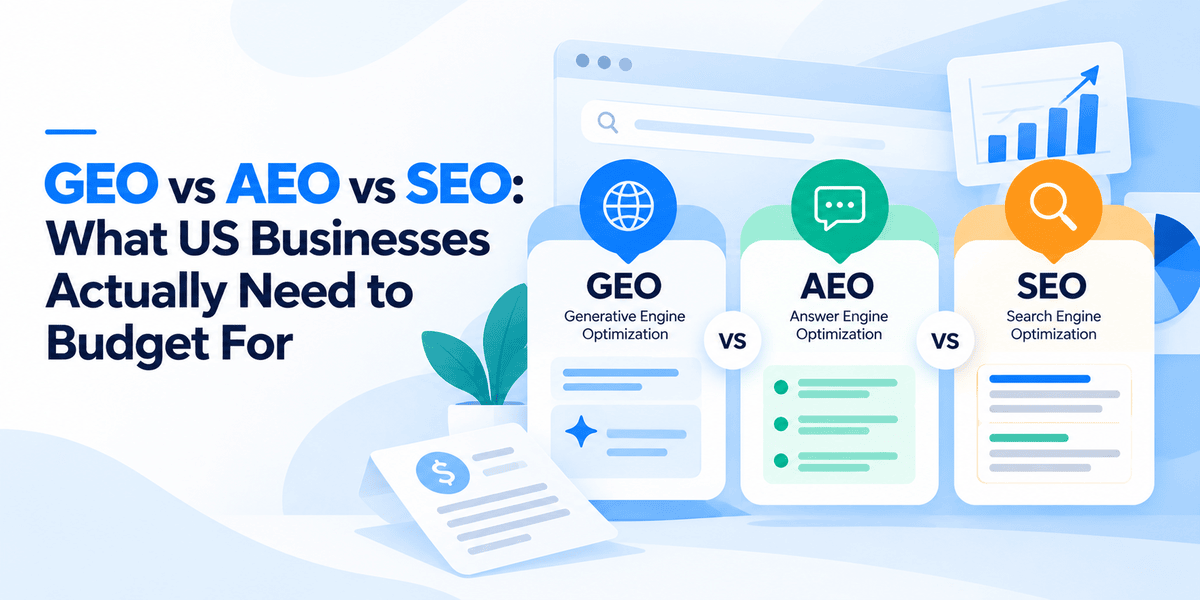
SEO earns you rankings. AEO structures your content so it can be lifted as a direct answer. GEO builds the entity signals that make an AI assistant recommend you by name. They overlap far more than the three acronyms suggest, and as of September 2026 AI assistants send under 1% of all web referral traffic. That single number should change how you budget for this.
What does each term actually mean?
The definitions have settled enough to be useful, even if the industry has not settled on which acronym wins.
SEO | AEO | GEO | |
|---|---|---|---|
Full name | Search engine optimization | Answer engine optimization | Generative engine optimization |
What it optimizes | Your ranking position for a query | Your content’s structure, so it can be extracted as a direct answer | Your identity as an entity a model can recognize and recommend |
Where the result appears | The ten blue links | Featured snippets, AI Overviews, voice answers | Named recommendations inside ChatGPT, Gemini, Perplexity, Copilot |
How you measure it | Rankings, impressions, clicks | Snippet and AI Overview capture rate | Citation share of voice across buyer prompts |
Core tactics | Keywords, links, technical health, content depth | Answer-first writing, question headings, FAQ schema, tables | Entity schema, directory consistency, reviews, third-party mentions, digital PR |
You will also see AIO, LLMO, AISO and a few others in circulation. They are largely the same work under different labels. Do not buy on the acronym. Buy on the deliverables, and ask what specifically gets done each month.
The overlap nobody mentions
Here is what most comparison articles leave out: the majority of the work counts for two or three of these at once.
Schema markup serves all three. Answer-first writing serves AEO and GEO, and increasingly helps SEO because Google rewards the same clarity. Reviews and third-party mentions serve GEO and local SEO equally. Site speed and crawlability are prerequisites for everything.
The genuinely GEO-only work is narrower than it sounds. It comes down to two things: prompt-level monitoring across AI platforms, and off-site co-citation building aimed specifically at what models read about you.
That has a direct commercial consequence. If a proposal lists SEO, AEO and GEO as three separate line items with three separate fees, you are probably being charged three times for overlapping work. Ask which deliverables are unique to each line.
The number that should change your budget maths
Cloudflare Radar data published on 3 September 2026 puts Google at 88.55% of web search referrals. ChatGPT sits at 0.531%. Claude is at 0.30%. Gemini and Perplexity fall below the reporting threshold entirely.
The trend is worth reading carefully. ChatGPT spiked to 0.913% in July 2026, then fell 42% in four weeks back to 0.531%. Year on year it grew from 0.208% to 0.531%, a 2.6x increase. That is real growth on a very small base.
Meanwhile Google’s referral share actually rose 6.88 points over the same year, largely because TikTok collapsed from 10.43% to 1.98%.
So when an agency suggests moving half your budget to chase AI referral traffic, understand what they are recommending: chasing under 1% of referrals. The traffic is not there yet.
Then why does any of this matter?
Because the damage is not happening in ChatGPT. It is happening inside Google.
When an AI Overview appears on a Google result, click-through rate drops 46.7% in relative terms, from 15% to 8%, across a Pew Research sample of 68,000 queries. Zero-click searches rose from 56% to 69% in a single year. That traffic did not migrate to ChatGPT. It evaporated.
This is the point almost every article on this topic misses. Google’s AI Overviews are an answer engine. AI Mode is an answer engine. They run on the same signals that GEO and AEO address: extractable content, clear entity identity, third-party corroboration.
So answer-engine work is not a bet on ChatGPT overtaking Google. It is how you stay visible inside Google as Google turns itself into an answer engine. That is a far safer bet, and a far easier one to justify to a finance director.
How should you actually split the budget?
Stop thinking of it as three budgets. It is one budget with a shifting emphasis, and the right emphasis depends on how much ranking equity you already have.
Your situation | Traditional SEO | Answer-engine work (AEO + GEO) | Why |
|---|---|---|---|
New site, few rankings | 40% | 60% | Nothing to defend, and answer-engine visibility is faster to earn on a young domain |
Some rankings, growing | 55% | 45% | Rankings starting to produce revenue, but plenty of headroom |
Established rankings | 65% | 35% | You have equity worth protecting from AI Overview erosion |
Category leader | 70% | 30% | Brand demand already strong; the job is defending it |
Adjust toward answer-engine work if your buyers research through AI tools, which is increasingly common in B2B. Adjust toward traditional SEO if you already rank well for terms that still drive revenue, because those rankings are an asset worth defending.
What if you can only fund one thing?
Fund the overlap. These deliverables serve all three disciplines simultaneously and should be the first money you spend.
- Make sure AI crawlers and search crawlers can reach and render every important page.
- Add Organization, Person and FAQPage schema, and keep it valid.
- Rewrite your top five pages so each answers its own question in the first 60 words.
- Claim and complete your Google Business Profile, and make your name, address and phone identical everywhere.
- Build review volume and ask for third-party mentions.
None of that is exotic, and all of it pays into every version of search visibility at once. Only once it is done does specialist GEO work, such as prompt-level monitoring and targeted digital PR, start earning its keep.
The uncomfortable bit
An agency that sells GEO as a separate product on top of your existing SEO retainer has a commercial interest in these three acronyms being genuinely distinct disciplines. Mostly, they are not.
What you should want is one strategy that covers all three, priced once, with a clear statement of which deliverables address which. If nobody will give you that, you are buying acronyms rather than outcomes.
Which of the three do you actually need?
The answer depends on your existing rankings, your industry, and whether your buyers use AI assistants to shortlist providers. We will run the prompt test, look at where you currently rank, and tell you which of the three deserves your budget first — including when the answer is that you do not need us yet.
Frequently Asked Questions
What is the difference between GEO and SEO?
SEO optimizes your ranking position for a query so someone clicks your link. GEO optimizes your identity as a business an AI model recognizes, so it recommends you by name inside a generated answer. SEO is measured in rankings and clicks; GEO is measured in citation share across buyer prompts.
What is answer engine optimization (AEO)?
AEO is structuring content so it can be extracted as a direct answer — in a featured snippet, an AI Overview, or a voice result. In practice that means answering the question in the first 60 words, using question-shaped headings, adding FAQ schema, and writing claims that make sense lifted out of context.
Do I need GEO, AEO and SEO separately?
No. Most of the work overlaps — schema, crawlability, answer-first writing and reviews serve all three at once. Only prompt-level monitoring and off-site co-citation building are unique to GEO. If a proposal charges three separate fees, ask which deliverables are genuinely unique to each.
How much AI search traffic am I actually missing?
Less than most agencies imply. Cloudflare Radar data from September 2026 shows Google at 88.55% of web referrals, ChatGPT at 0.531% and Claude at 0.30%. The real cost of ignoring AI search is not lost ChatGPT referrals — it is lost clicks inside Google, where AI Overviews cut click-through rate by 46.7%.
Is SEO dead because of AI?
No. Google’s referral share rose 6.88 points in the year to August 2026. What has changed is that ranking first no longer guarantees a click: zero-click searches rose from 56% to 69% in a year. SEO still matters; it now needs answer-engine work alongside it.
What percentage of my budget should go to AI search optimization?
Roughly 60% for a new site with few rankings, dropping to about 30% for an established category leader with equity worth defending. Shift higher if your buyers research through AI assistants. Treat it as one budget with a changing emphasis, not three separate line items.