

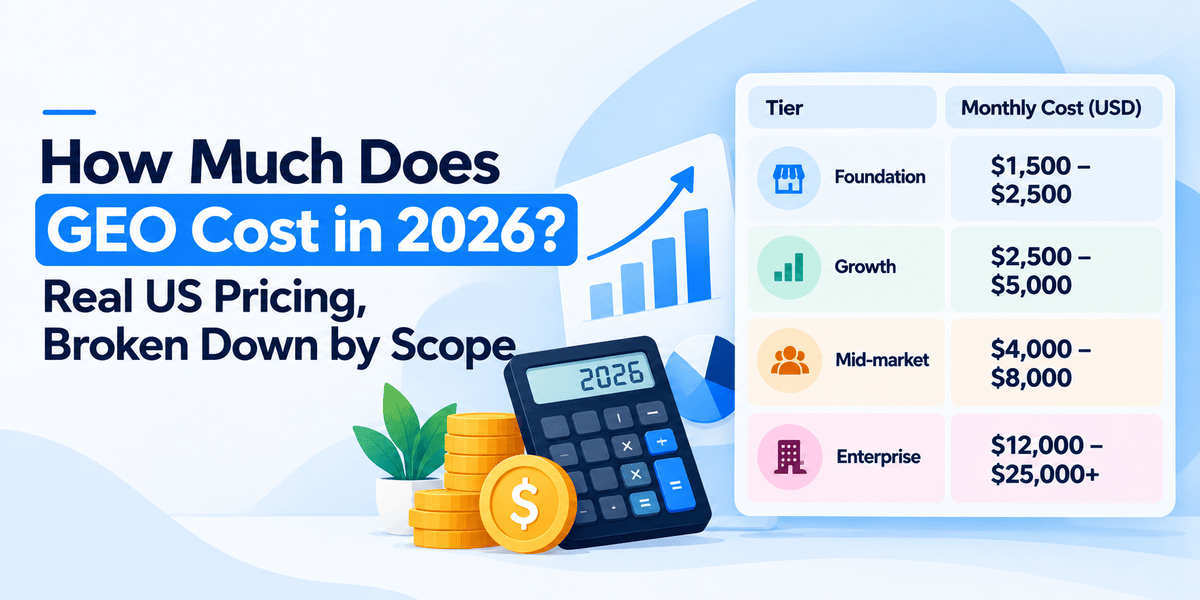
As of September 2026, generative engine optimization costs US small businesses $1,500 to $5,000 per month, mid-market companies $4,000 to $8,000, and enterprises $12,000 to $25,000 or more. One-time audits run $2,500 to $5,000. Project engagements span $5,000 to $50,000. Below is what each tier actually buys, what pushes a quote up, and how to tell a fair price from a padded one.
Why GEO costs more than traditional SEO
Start with the baseline. Ahrefs surveyed 439 SEO providers and found the average agency retainer sits at $3,209 per month, freelancers at $1,349, and consultants at $3,250. Hourly rates cluster between $100 and $150, averaging $111. Project work most commonly lands between $2,501 and $5,000.
GEO typically carries a 20% to 40% premium over those numbers. That premium is not markup for a fashionable acronym. It pays for three workstreams traditional SEO does not include.
The first is monitoring. There is no Search Console for ChatGPT. Nobody sends you a weekly report saying you were cited in 14% of relevant answers. Somebody has to run the prompts, record the results, and track them over time, across four or more platforms, every month. That is real recurring labor.
The second is entity work. Traditional SEO optimizes pages. GEO optimizes the model’s understanding of your business as a thing that exists, which means schema, directory consistency, review volume and third-party mentions. Much of it happens off your website entirely.
The third is off-site citation building. Large language models weight what other sites say about you far above what you say about yourself. Earning those mentions means digital PR, which is slower and more expensive than publishing another blog post.
What you are actually paying for
Any legitimate GEO engagement covers five things. If a quote does not account for all five, ask which ones are missing and why.
- AI visibility monitoring. Structured prompt testing across ChatGPT, Gemini, Perplexity and Copilot, tracked monthly against named competitors.
- Entity and schema work. Organization and Person schema, consistent name-address-phone data across every directory, Google Business Profile optimization.
- Content restructuring. Rewriting existing pages so answers appear in the first 60 words, adding FAQ blocks with valid markup, making claims self-contained enough to be quoted.
- Off-site citation building. Editorial placements, expert quotes, directory listings, review acquisition.
- Reporting. Citation share of voice against competitors, plus AI referral traffic properly segmented in analytics.
How much does GEO cost by business size?
The ranges below are US market rates as of September 2026.
Tier | Monthly cost | Typical buyer | What it covers |
|---|---|---|---|
Foundation | $1,500–$2,500 | Local service business, single location | Monthly AI visibility testing, schema, directory profiles, review acquisition, 2–3 pages restructured per month |
Growth | $2,500–$5,000 | Multi-location SMB, small DTC brand | Everything above, plus 2–4 editorial placements monthly, original citation-bait content, competitive share-of-voice tracking |
Mid-market | $4,000–$8,000 | 50–500 employee companies | Full GEO strategy, 8–12 content pieces monthly, technical SEO, entity optimization, dedicated reporting |
Enterprise | $12,000–$25,000+ | Multi-brand, multi-market | 20+ content pieces, custom answer-engine monitoring, dedicated strategist, governance across markets |
Sources: small business tiers, agency tier pricing, mid-market and enterprise ranges.
What does each engagement model cost?
Retainers are the most common arrangement, and for good reason: GEO results compound, and a three-month engagement rarely shows much. But they are not the only option.
Model | Cost | Best for | Watch out for |
|---|---|---|---|
Agency retainer | $1,500–$8,000/month | Ongoing work where off-site citation building matters | Twelve-month lock-ins before you’ve seen any output |
One-time audit + restructure | $2,500–$5,000 (up to 20 pages) | Fixing the foundations before committing to a retainer | A report with no implementation attached |
Project engagement | $5,000–$50,000 | Site migrations, large restructures, launches | Scope creep; get deliverables listed in writing |
Freelancer / consultant | $125–$250/hour, or $3,500–$6,000/month | Strategy and oversight when you have an internal team to execute | Single point of failure; no PR capability |
In-house hire | $70,000–$110,000/year salary, plus $6,000–$10,000/year in tools | Companies publishing at high volume year-round | Total cost is roughly $8,000/month once tools and overhead are counted |
DIY | $0 in tools, 4–6 hours/month | Businesses under $1,000/month of available budget | Caps out quickly; you cannot DIY third-party press coverage |
What moves your quote up or down?
Six factors explain most of the variation between two quotes for what sounds like the same work.
Industry. SaaS, fintech and healthcare carry 30% to 50% markups. The competition is fiercer, the compliance burden is heavier, and the content requires genuine subject expertise.
Whether content creation is included. This is the single largest swing. A strategy-and-implementation retainer with no content production can cost half what a full-service retainer does. Check this line item first when comparing quotes.
Who implements. Some agencies deliver a strategy document and expect your developer to execute it. Others do the work. The second is more expensive and usually cheaper in practice, because the first often produces a document nobody ever implements.
Site size. Twenty pages is a different job from two thousand.
How many platforms get tracked. Monitoring ChatGPT alone is far cheaper than tracking four platforms across dozens of prompts.
Geographic scope. One city is not fifty states.
How do you tell a fair quote from a padded one?
Five things worth asking before you sign anything.
Ask what they will measure and how. If the answer is rankings and traffic, they are selling traditional SEO with a new label. GEO is measured in citation share of voice across named prompts. A provider who cannot describe their measurement method does not have one.
Ask for their prompt list. Any real GEO engagement starts with twenty to thirty questions your actual buyers ask. If they cannot show you a sample, the engagement has no baseline and you will never know whether it worked.
Ask what happens off your website. A GEO proposal that is entirely on-site work is an SEO proposal. Off-site citation building is where most of the durable advantage lives.
Ask about reporting cadence and contents. Monthly is standard. A report that shows only traffic is not a GEO report.
Be careful with guarantees. Nobody controls what ChatGPT says about your business. A provider guaranteeing citations is either misunderstanding the mechanism or misrepresenting it. Guaranteed deliverables are reasonable. Guaranteed outcomes are not.
What should you do with a limited budget?
Not every business can spend $3,000 a month, and the honest answer is that some should not.
Under $1,000 a month. Do it yourself. The highest-value GEO work costs nothing but time: unblocking AI crawlers, adding Organization schema, rewriting your top five pages to answer their questions in the opening, claiming and completing your Google Business Profile, and asking customers for reviews. That is four to six hours a month and it captures a meaningful share of what a foundation-tier retainer delivers.
$1,000 to $2,500 a month. Buy a one-time audit and implementation rather than a thin retainer. A $2,500 project that fixes your schema, restructures your key pages and establishes a measurement baseline will do more than eight months of a stretched retainer that never reaches critical mass.
$2,500 and above. A retainer starts to make sense, because off-site citation building requires sustained effort and is the part you cannot replicate yourself.
The uncomfortable part
GEO spending only pays back if there is something worth citing. An agency can make your website crawlable, structured and well marked up, and an AI assistant will still decline to recommend a business with four reviews and no third-party mentions.
If your budget is limited, spending it on genuinely earning reviews and press coverage will move your AI visibility further than spending it on schema markup. The technical work is necessary. It is not what makes a model choose you.
What a quote for your business would look like
Pricing depends on your site size, your industry, how much content you need and how much of the work you can absorb internally. We will look at your site, run the prompt test to see where you currently stand, and give you a scoped number rather than a range.
Frequently Asked Questions
How much does GEO cost per month?
GEO costs US small businesses $1,500 to $5,000 per month as of September 2026. Mid-market companies typically pay $4,000 to $8,000, and enterprises $12,000 to $25,000 or more. One-time audits without an ongoing retainer run $2,500 to $5,000.
Is GEO more expensive than SEO?
Yes, typically 20% to 40% more. The premium covers three things traditional SEO does not include: monthly prompt testing across multiple AI platforms, entity and schema work that happens largely off your website, and off-site citation building through digital PR.
Is GEO worth the cost for a small business?
It depends on whether your customers use AI assistants to find providers like you. If they do, and you currently do not appear, the cost of invisibility is higher than the retainer. If you have very few reviews or third-party mentions, fix that first — schema markup will not compensate.
Can I do GEO myself?
Partly. Unblocking AI crawlers, adding Organization schema, restructuring your top pages to answer questions in the first 60 words, and building reviews are all DIY-able in four to six hours a month. Earning third-party press coverage is the part that realistically needs help.
How long before GEO pays for itself?
Technical fixes can show results in two to four weeks. Entity and schema work takes one to three months. The off-site citation building that drives consistent recommendations takes three to six months. Budget for six months before judging the investment.
What should a GEO proposal include?
A sample prompt list of 20 to 30 buyer questions, a stated measurement method based on citation share of voice, a defined scope of off-site work, monthly reporting, and a clear line on whether content creation and implementation are included. Guaranteed deliverables are fine; guaranteed citations are not.